Thoughtful Gifts for the Couple Who Hates Stuff
Some couples hate stuff. Not in the "I'll find space for it" sense. In the "every object on every surface fills me with low-grade dread" sense.
If you've ever bought a thoughtful candle for someone like this and watched them try to figure out where to put it, you know the problem. The instinct of most gifters is to escalate to "experience gifts." But most experience gifts are also bad: vague vouchers, hot air balloon rides for two, paint-and-sip classes that nobody actually wants to attend.
Here's the better category. Real gifts for couples who don't want more stuff.
1. The 36 questions card deck
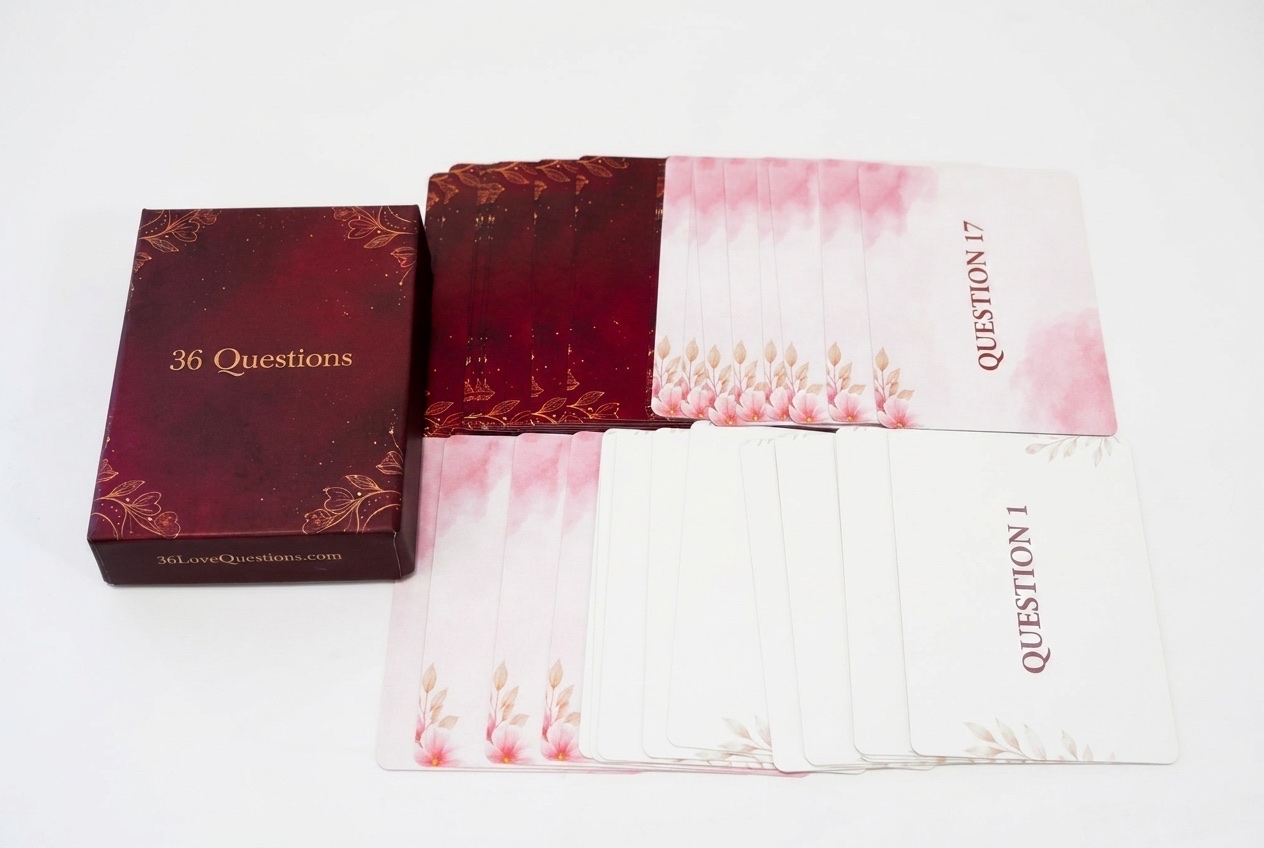
Yes, the deck is technically a "thing." But it's the smallest possible class of thing: a thin boxed object that lives in a drawer and produces an entire evening when you take it out.
The reason it works for stuff-averse couples: the gift is not the object. The gift is one specific evening you've planned for them. The deck is the artifact.
The pitch when giving it: "You don't have to keep this on display. Stick it in a kitchen drawer. Pull it out one Saturday and do all of them with a bottle of wine."
Most stuff-averse couples are not actually averse to objects-with-purpose. They're averse to objects-without-purpose. A card deck that produces a specific night is the first kind, not the second.
The deck is here. Comes in a small box that doesn't add to anyone's clutter.
2. A specific, paid-for, dated night in
Not a voucher. A booking. A specific date, a specific restaurant or babysitter or hotel room, paid in full, calendar invite forwarded.
The friction of "you have to plan it" is what kills voucher gifts. Stuff-averse couples are usually high-agency people who already have things on their list. What they don't have is time and the executive function to book the thing. Removing both is the gift.
The version that works best: pick something the couple has talked about, book it for a specific date six weeks out, send the calendar invite, and pay for it. "Don't argue. Just go."
3. A really good meal kit for one specific dish
Not a meal kit subscription. One dish, one delivery: the right ingredients, the right wine, the right recipe printed on heavy paper.
This is a gift that gets used and then disappears. No object remains; only a meal.
The trick: pick a dish that is too elaborate to bother with on a normal Tuesday. Slow-braised beef cheek. Hand-rolled pasta. A layered cake. Something that requires the gift in order to happen.
4. A donation to something they care about
For couples who genuinely hate stuff, a thoughtful donation to a cause they care about (in their name, with the receipt) is usually a better gift than another candle.
A note on doing this well:
- Donate to a specific organization they've mentioned, not a generic one.
- Include the donation receipt with a personal note. The receipt makes it real.
- Make the amount slightly larger than feels comfortable. The thoughtfulness lives in the size.
This works for couples whose values are louder than their consumer preferences.
5. A subscription to one narrow thing
A subscription to one tightly-defined thing they'll love: a specific magazine, a specific tea, a specific newsletter. The narrower the better.
Subscriptions don't add to the pile of objects in someone's house. They add to the pile of experiences. A weekly poem in the inbox is not stuff. A monthly bottle of natural wine is consumed and gone.
6. A booked babysitter weekend
If they have kids and you're feeling generous: pre-pay for a babysitter weekend. Find a local agency, book it, hand them the confirmation. "Pick the weekend. Don't argue."
This is the most-loved category of gift among new parents and is the opposite of stuff. You're literally giving them an absence of obligations.
7. A photographer for one hour
A skilled local photographer for one hour, in their home or at a place that means something to them. The output is digital files; nothing physical needs to enter their house unless they want to print one.
Most couples have no good photos of themselves together that aren't from their wedding day. A skilled person for an hour can fix that, and the result is a non-physical asset.
8. A guided experience by a real expert
Not a vague "experience gift card." A specific guided experience: a foraging walk with a real mycologist, a private architecture tour with a local historian, a museum hour with a trained docent, a tasting menu with the winemaker.
The constraint: must be guided by an actual expert, must be specific, must be booked.
These produce stories. Stories don't take up shelf space.
9. A renewed thing they already have
For stuff-averse couples, the best gift is sometimes something they already own, but better. A really good photo of one of their existing pieces of art, professionally restored. A re-binding of their favorite book. A re-shoeing of their favorite armchair.
The pattern: they keep what they already have; the gift is its renewal. Zero net new stuff.
10. A paid-for class that one of them has wanted to take
Pottery, language, knife skills, stained glass, sailing. Not a "voucher to take a class": a specific class, on a specific date, with the registration done.
The class is the gift. The output of the class is the learning, not a take-home object.
A note on what makes a "no stuff" gift actually good
Two things separate the good non-stuff gifts from the bad ones:
- It's specific, not abstract. "An experience" is not a gift. "Tickets to this concert on this date" is a gift.
- It's pre-decided, not pre-deferred. A voucher is a gift you handed back to the receiver to plan. A booked thing is a gift you actually gave them.
If you remember those two rules, you'll never buy a bad anti-clutter gift again.
A short script for handing over a non-stuff gift
The biggest failure mode of these gifts isn't the gift. It's the handoff. A booked babysitter weekend handed over with "I didn't know what to get you so I just paid for someone" reads as effortless and slightly confusing. The same gift handed over with a small script lands completely differently.
A version that works:
"I know you don't really want more things, so I got you something that's not really a thing. Saturday the 18th is taken care of: sitter is booked from 6pm to 10am Sunday, paid, here's her contact. Don't argue. Pick a hotel or stay at home, your choice."
Three components do the work: the acknowledgment (I know you don't want stuff), the specificity (the 18th, the sitter is named, paid in full), and the permission to receive (don't argue). Skip any of the three and the stuff-averse recipient will instinctively try to give the gift back.
The same script template works for nearly every category in this list. "I know you don't want stuff. Here's a specific thing on a specific day. It's already paid for / booked / arranged. You don't have to do anything." Memorize that pattern; it solves the hardest part of giving non-stuff gifts.
And if you want a small physical object that produces an evening, the deck is right here. It's the kind of thing minimalists keep in a drawer for a decade and pull out three times a year for a real night together. That's about as un-clutter-y as a gift gets.