Date Night Ideas at Home When You've Run Out of Conversation
The standard advice for at-home date nights is the same five suggestions cycled forever: cook together, watch a movie, take a bath, paint each other, do a puzzle. They're fine. They're also not what most couples need after the second year.
The harder problem most couples have at home isn't what to do: it's that the things they've been doing have stopped producing connection. They've been cooking together for years and it's now just cooking. The movie is just a movie. The puzzle has stopped feeling like time together and started feeling like parallel play.
This is a list of at-home date nights that do something, ones designed to produce attention, conversation, or shared state, not just shared time.
1. The 36 Questions, properly
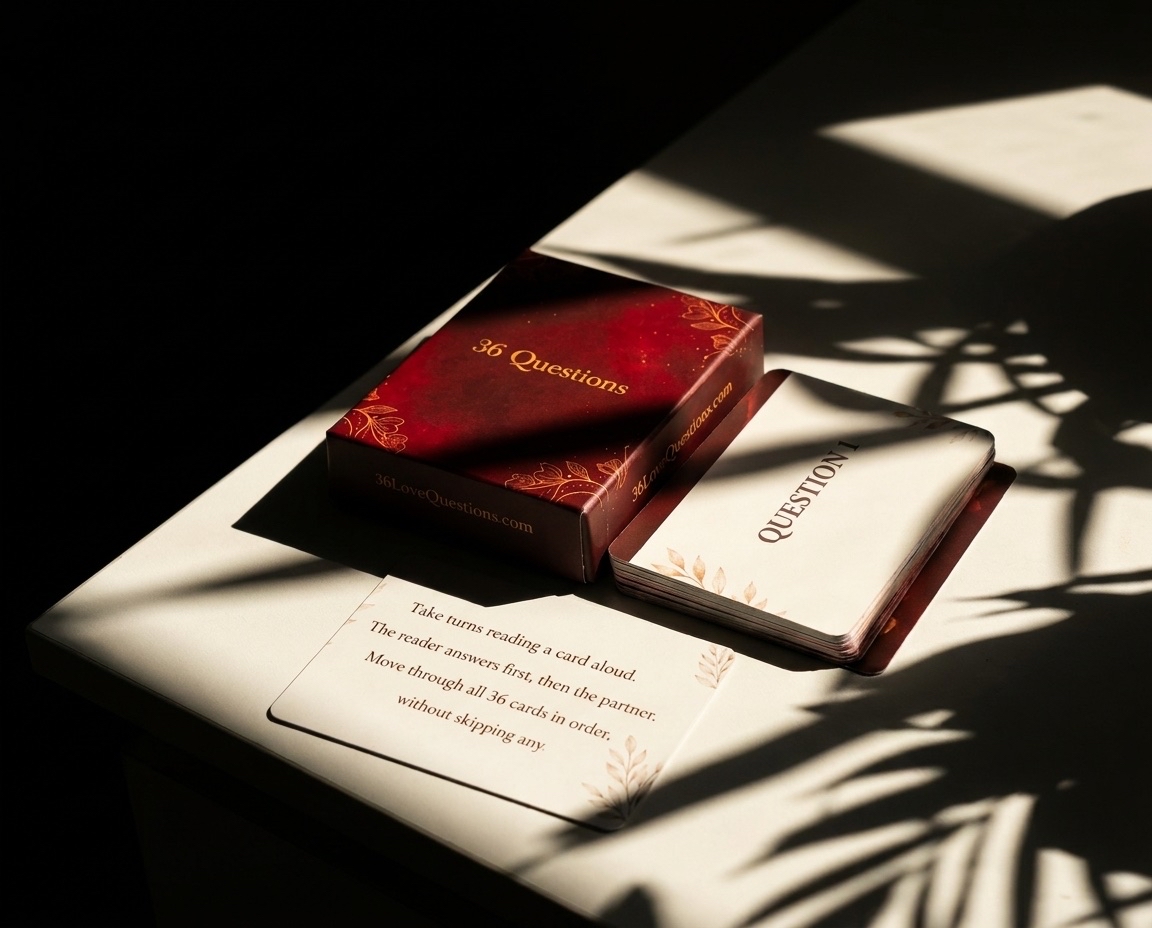
This is what we make a card game for, so we're biased, but it deserves to be on this list because it consistently works.
The pitch: 36 questions designed to escalate honest conversation, in three sets, ending in four minutes of eye contact. Plan 90 minutes. No phones. The full guide is here.
Why it works at home: the form requires being in one room, focused on each other, with nothing else competing. Most "at home dates" fail because the home is still demanding things of you. The 36 questions force the home to recede for an hour and a half.
When to use it: any night you can carve out two hours, but especially when you and your partner have been together long enough to assume you "know" each other.
2. The 30-minute walk, then dinner
Counts as "at home" if you're starting and ending at home.
Walk for 30 minutes around your neighborhood, then come home and cook (or eat) dinner together. The walk is the date.
Why it works: walking side by side is the easiest format on earth for unstructured honest conversation. Eye contact is removed; the body is in motion; awkward pauses are absorbed by the act of walking. People say things on walks they wouldn't say across a table.
Add a small constraint: take a different route than your usual one. New scenery prompts new conversations. Same neighborhood, same partner, different streets: surprisingly different conversation.
3. Cook one elaborate thing, together, no phones
The "cook together" date is overrated when it's "you do the salad, I do the pasta." It's underrated when it's one dish that takes two hours and requires both of you for several steps: handmade pasta, dumplings, a layered dessert, a slow-braised meat.
The pitch: pick something neither of you has made before. Source the recipe in advance; both of you read it. Phones away while you cook. Drink something you don't usually drink.
Why it works: a hard cooking project produces real shared state: the same problem to solve, the same uncertainty about whether it'll work, the same satisfaction when it does. It's a simulator for working together on something that matters, but with low stakes.
4. Two-question dinner
A small ritual that's easier to sustain than the full 36 questions.
The setup: at dinner, instead of the usual "how was your day?" exchange, each of you asks the other one question, but it has to be a question you've never asked before in your relationship. No work-related questions allowed.
We keep a small list of these on hand. A few that have worked:
- What's a piece of advice you've been given that you've quietly chosen to ignore?
- What's something you're better at now than you were five years ago?
- What's a conversation you wish we had more often?
- What's a small thing I do that you've never told me you appreciate?
- What's something you used to believe about us that you've updated on?
Two questions per dinner. Not a quiz, just a way of keeping the curiosity lane open.
5. The "no plans" night
The most under-used at-home date night is structured emptiness.
The setup: block 3 hours. No TV, no movie, no phones, no plan. Just be in the same room with your partner, with nothing to do.
This sounds awful. It's not. After about 20 minutes the boredom turns into something: a conversation that wouldn't have started, a project one of you has been thinking about, a long affectionate silence on the couch, a decision to go to bed early together. The point of the no-plans night is to find out what your relationship spontaneously generates when nothing is competing for it.
We've had couples write to us that they discovered they had a "favorite kind of evening" they had stopped having because everything had been planned out of it.
6. Old-letters night
Pull out something from earlier in your relationship: old text threads, early emails, photos from your first year, the journal you kept that one summer. Read them out loud to each other.
The pitch: 90 minutes of revisiting your earlier selves, together. Pour something good. No phones for non-archival use.
Why it works: re-encountering your earlier relationship is a fast way to recalibrate the current one. You'll laugh, cringe, soften. You'll remember things you'd forgotten about each other. The contrast between then and now is almost always tender.
7. The reverse-interview
One of you asks the other questions (only questions) for 30 minutes. Then you switch.
The interviewer can't share their own answers, can't tell stories, can't say "oh, me too." Just questions and active listening.
Then you switch.
This sounds awkward and is actually transformative. Most couples have never been on the receiving end of 30 uninterrupted minutes of their partner's curiosity in the last few years. Doing this once produces a noticeable affection bump for days.
8. The thing one of you actually wanted to do
Almost every couple has at least one "we should do this" item that's been on the list for years and never happened, because it requires picking a night, telling a babysitter, deciding who buys the supplies. Wine and paint. A dance class video. A board game. Stargazing on the roof. Building the IKEA thing together that's been in the box for two months.
Pick the thing one of you actually wanted, and just do it on a Tuesday.
The pitch isn't novelty. It's that executing the thing (the thing that's been sitting on the list) is itself the date. The relief of "we finally did it" is more bonding than the activity itself.
9. Read the same essay, then talk about it for 20 minutes
A small format that punches above its weight: each of you read the same long essay (15–25 minutes of reading), then talk about it for 20 minutes.
This works because most couples have stopped sharing intellectual material. Your reading lives are parallel. A shared essay creates a shared object to think about.
Pick something neither of you has read. Pick something a little provocative. The shared essay is the date.
10. The 36 questions, again
Yes, again. We mean it. Most couples who try the 36 questions once and like the experience never repeat them. The repeat is interesting, the answers change, the eye contact gets easier. Once a year is the right cadence.
If you want the deck (the boxed version that lives in a drawer near the kitchen and reminds you it exists), it's here. If you want the printable list, it's here. The form matters less than the practice.
What all of these have in common
The pattern across this list, if you noticed, is the same thing: a constraint that produces attention. Dinner-and-a-movie at home doesn't fail because it's bad: it fails because nothing in it requires your full attention on each other. Each of the dates above puts a structure around the evening that pulls attention back to the relationship.
That's the underrated truth about at-home date nights. The home is a forest of small attention-thieves. A good at-home date is anything that briefly clears the forest.