36 Questions for Long-Term Couples: When You Already Know Each Other

Most writing about the 36 questions assumes you're doing them with a stranger. Most people who actually do them are doing them with a partner of years.
The experience is genuinely different. Some questions are easier; some get harder; the eye contact lands completely differently. Here's what to expect, and how to do them when you've been together long enough to think you already know the answers.
What changes when you already know each other
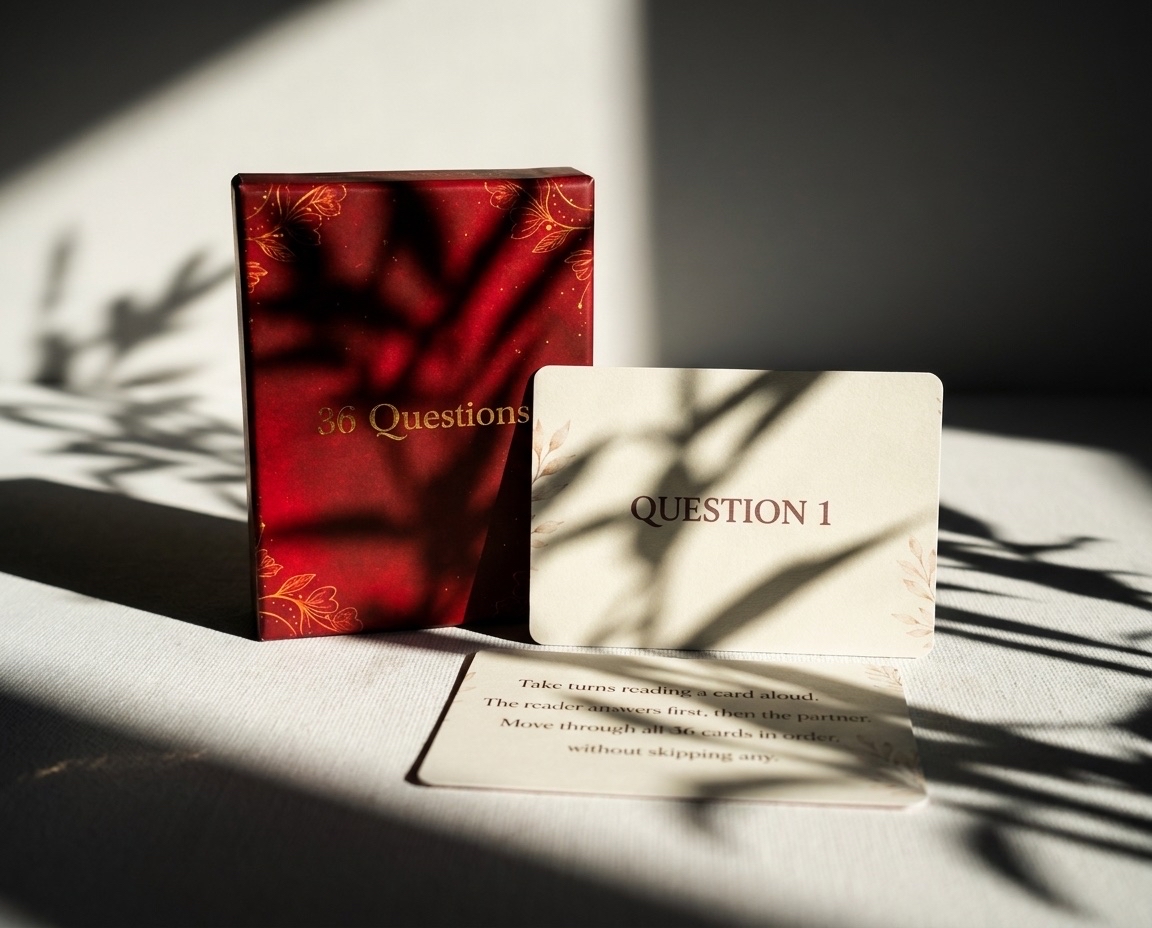
The first myth to dismantle: "we already know all this." Almost no long-term couple does. The 36 questions ask things that are surprisingly easy to spend a decade together without ever discussing directly.
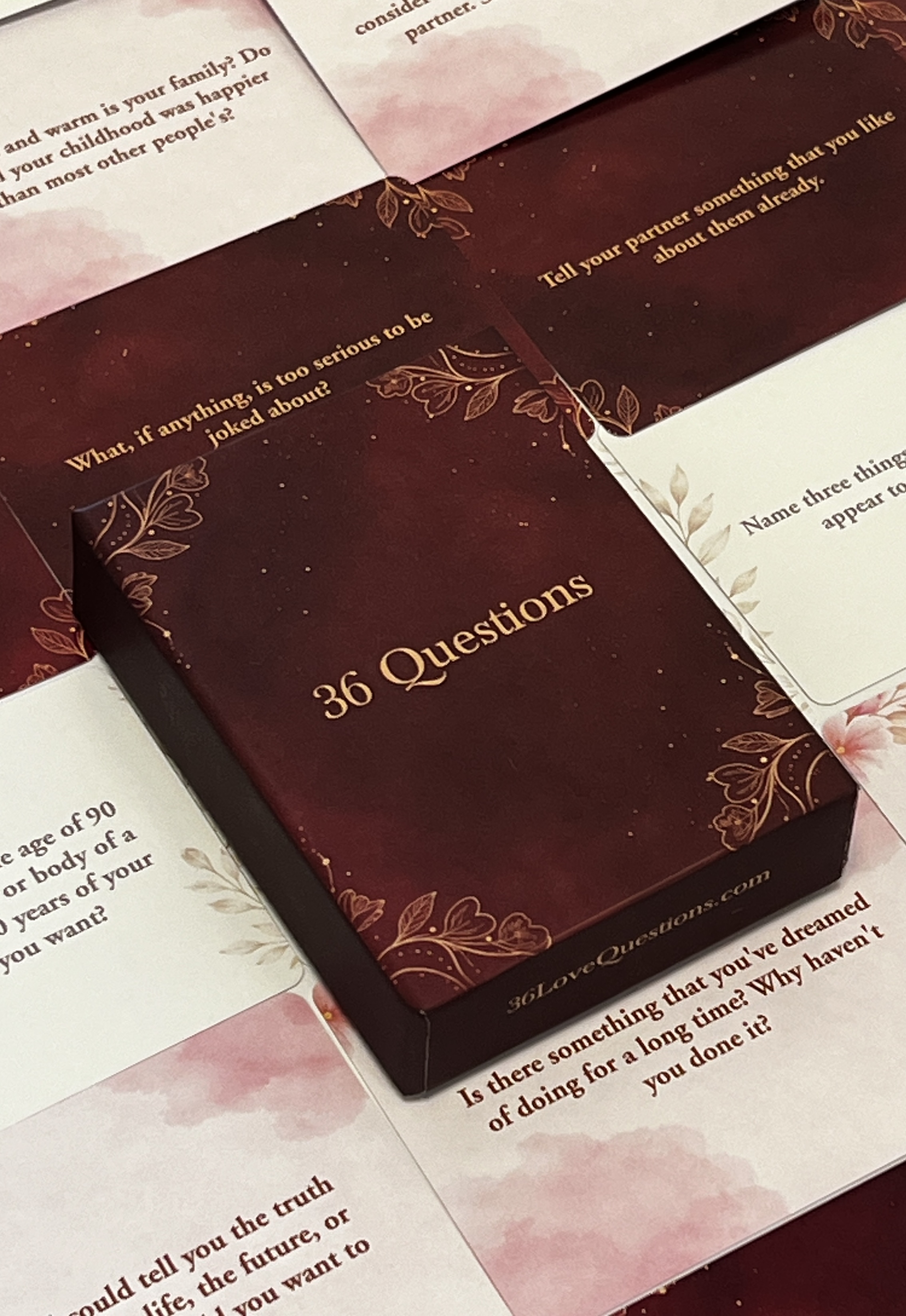
Take Card 14: Is there something that you've dreamed of doing for a long time? Why haven't you done it? Almost every couple I've talked to has answered this and surprised their partner, not because the dream was secret but because nobody had ever asked. The dream lived alongside the relationship, never inside it.
Other examples that consistently surprise long-term couples:
- Card 15 (greatest accomplishment): the answer often differs from what the partner would have guessed.
- Card 17 / 18 (most treasured / most terrible memory): partners often know the story but have never heard the words "treasured" or "terrible" attached to it.
- Card 21 (role of love and affection): almost no one has ever stated this out loud, even to a long-term partner.
- Card 27 (what would be important for a close friend to know about you): radically different at 35 than it would have been at 25, but you don't get to update each other's mental model unless you ask.
The closeness effect for long-term couples is smaller than for strangers, on the closeness scale used in the original study. But that's because long-term couples start much closer. The update (the new information) is often as large as for strangers. It just doesn't move the needle as far on a scale that's already pinned.
What gets harder
A few questions get genuinely harder, not easier, with a long-term partner. Be ready.
Card 28 (tell your partner what you like about them, things you might not say to someone you've just met). For a stranger, this is "you have a really nice laugh." For a long-term partner, it's the things you've felt for years and never quite found the right moment to say. Most long-term couples hit this card and one of them cries.
Card 22 (alternate sharing a positive characteristic of your partner, five total each). The fifth one is the hard one. If you can't think of five, you have an opportunity to look at why.
Card 30 (when did you last cry in front of another person? By yourself?). Long-term couples often realize they don't know the second answer.
Card 33 (what would you regret not having told someone?). For a partner of years, the obvious target is each other, and yet there's almost always a real answer that isn't each other.
What gets easier
A few things are dramatically easier:
- The four-minute eye contact, oddly, is much easier with a long-term partner. The early-minute discomfort that strangers report is mostly absent. Long-term couples tend to find it moving rather than awkward.
- Set III in general is easier: the trust required is already there.
- The pacing. Long-term couples can do the deck in 60 minutes flat without rushing. Strangers tend to need 90.
A protocol for long-term couples
A few small modifications worth making if you've been together a while:
Plan it as a date, not a "talk." The word "talk" makes long-term partners brace. Frame it as a 90-minute curiosity exercise: let's see if we still know each other. That framing is honest and it relaxes both of you.
Don't prepare answers. This is tempting for long-term couples, who instinctively think "I know what I'd say to this." Don't pre-rehearse. The closeness effect comes from spontaneous disclosure, not from delivering a polished answer.
Take the eye contact seriously. This is the part most long-term couples are tempted to skip: we've already looked at each other a million times. The four-minute eye contact in your eighth year is a genuinely different experience than your eighth date. Do it.
Talk afterwards. Long-term couples often have leftover material that the cards opened. Give yourselves an unstructured 30 minutes after the deck.
Which questions to skip (almost none)
Long-term couples are usually tempted to skip the questions they think they "already know." Don't. The point isn't to learn brand-new facts; it's to hear something familiar said in a slightly different way, in this room, today.
The only cards we'd genuinely consider skipping for long-term couples in particular circumstances:
- Card 35 (whose death in your family would you find most disturbing): if either partner has had a recent loss in the family, this card will land too hard. Substitute "share a moment when you felt protective of someone you love."
- Card 24 (relationship with your mother): if either partner is deeply estranged from their mother, this card sometimes derails the closeness curve. You can keep it but be ready for a longer pause.
Otherwise, do the deck as written.
What to expect afterwards
Long-term couples consistently report three things in the days after doing the questions:
- A short-term boost in physical affection. This is the most reliably reported effect: a week or two of holding hands more, more eye contact at dinner, more spontaneous touch.
- A new ongoing conversation thread. Couples often pick a question that resonated and keep returning to it for weeks. ("That dream you mentioned in card 14, did you mean…")
- A small recalibration. Almost no long-term couple finishes the deck with their model of each other unchanged. Often the change is small (I didn't know it felt that big to her), but the recalibration is real.
How often to repeat
Roughly once a year is the cadence most couples settle into. Anniversaries are a natural anchor. The closeness effect is smaller on repeat, but you'll be answering different things: your answers will have changed.
If you want a deck that quietly enforces the form so you actually do this each year, we make one. It's also a sturdier anniversary present than flowers.
A few specific moments long-term couples consistently describe
Across hundreds of long-term couples we've heard from, a small set of moments come up again and again as the parts of the night they remember:
- The pause before answering Card 14. ("Why haven't you done it?") Almost everyone hesitates here. The hesitation is usually the answer.
- Card 22's fifth positive characteristic. First four are easy. The fifth one forces you to actually think about who your partner has been to you, in specific terms. Couples often go quiet here for a real beat.
- The eye contact at minute 2. Most long-term couples report a strange, specific lift somewhere around the second minute, past the awkwardness, before the timer ends. Several people have described it as "I forgot what it was like to look at her without doing something else at the same time."
- The drive or walk home from the room you did it in. If you do the questions in your living room and then go to bed in your own house, the small "transition" walk to the bedroom is often where the warmest small things get said.
None of these are guaranteed; all of them are common enough that you should expect at least one of them to land.
The point of doing this with a long-term partner isn't to fall in love again. You're already past that. It's to remember that the person across the table is, after all this time, still mostly an interior you don't have access to. That's a useful thing to remember once a year.