36 Questions to Fall in Love: The Full List, With Commentary
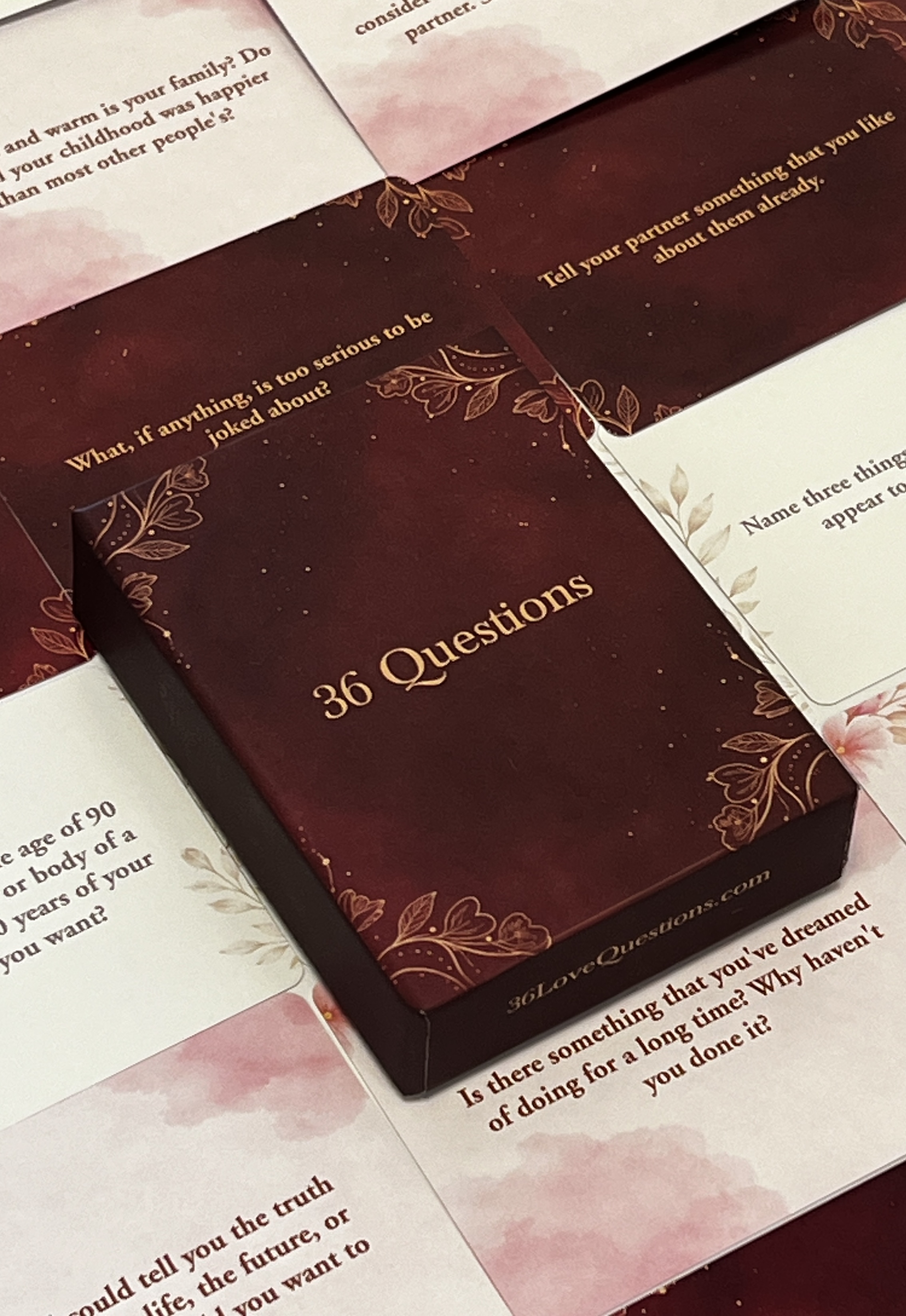
Here is the full, original list of the 36 questions from Aron, Melinat, Aron, Vallone & Bator's 1997 paper, The Experimental Generation of Interpersonal Closeness. Three sets of twelve, in the order they were tested.
I've added a one-line note under each question explaining what it's actually probing. The notes aren't in the original paper. They come from reading the procedure section closely and from watching hundreds of couples do these questions.
A reminder of how to use the list: take turns reading. The reader of a card answers first, then their partner answers. Don't skip, don't paraphrase, do all 36 in one sitting, end with four minutes of eye contact.
Set I: Warm-up & light disclosure
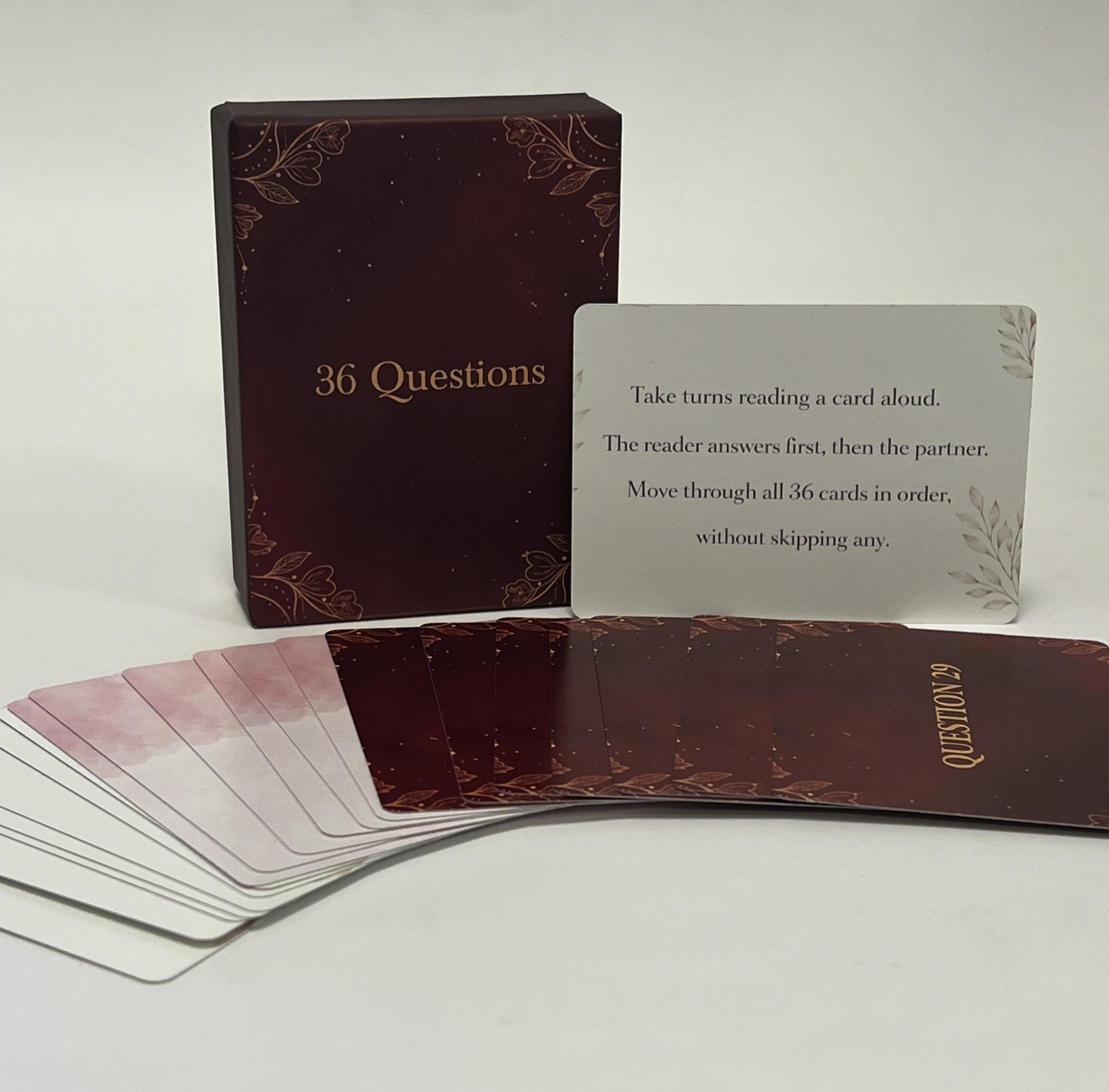
The point of Set I is to get both of you talking about yourselves out loud, without anything yet feeling risky.
1. Given the choice of anyone in the world, whom would you want as a dinner guest? Tells you who someone admires, usually more revealing than they realize.
2. Would you like to be famous? In what way? Probes how someone wants to be seen by strangers.
3. Before making a telephone call, do you ever rehearse what you are going to say? Why? An anxiety question disguised as a habits question.
4. What would constitute a "perfect" day for you? Reveals what someone enjoys when no one's watching.
5. When did you last sing to yourself? To someone else? A question about uninhibited joy.
6. If you were able to live to the age of 90 and retain either the mind or body of a 30-year-old for the last 60 years of your life, which would you want? A values question dressed up as a thought experiment.
7. Do you have a secret hunch about how you will die? Skip this one if it's too heavy for the moment, but most people have an answer they've never said aloud.
8. Name three things you and your partner appear to have in common. The first "we" question. Pay attention to what comes to mind.
9. For what in your life do you feel most grateful? Always slows the room down.
10. If you could change anything about the way you were raised, what would it be? A childhood question that lets people answer at any depth.
11. Take four minutes and tell your partner your life story in as much detail as possible. Set a timer. Genuinely take the four minutes.
12. If you could wake up tomorrow having gained any one quality or ability, what would it be? Reveals what someone feels they're missing.
Set II: Hopes, fears, and self-image
Set II is where the temperature rises. The questions move from preferences to values, from past to identity.
13. If a crystal ball could tell you the truth about yourself, your life, the future, or anything else, what would you want to know? A question about which uncertainty haunts someone most.
14. Is there something that you've dreamed of doing for a long time? Why haven't you done it? Pay attention to the second half. That's where the real answer lives.
15. What is the greatest accomplishment of your life? Notice whether someone names something obvious or something private.
16. What do you value most in a friendship? This is a sneak preview of what they'll value in a partner.
17. What is your most treasured memory? Often the most moving question in Set II.
18. What is your most terrible memory? Usually answered shorter than #17. That's normal.
19. If you knew that in one year you would die suddenly, would you change anything about the way you are now living? Why? A clarifying question disguised as a morbid one.
20. What does friendship mean to you? Notice if their definition is about loyalty, fun, depth, or honesty.
21. What roles do love and affection play in your life? A direct question about how someone relates to love itself.
22. Alternate sharing something you consider a positive characteristic of your partner. Share a total of five items. The first explicit reciprocity exercise. Don't rush this one.
23. How close and warm is your family? Do you feel your childhood was happier than most other people's? A question that often reveals more than #10.
24. How do you feel about your relationship with your mother? Set II ends here on purpose. It's the bridge into Set III.
Set III: Vulnerability, mortality, and "we"
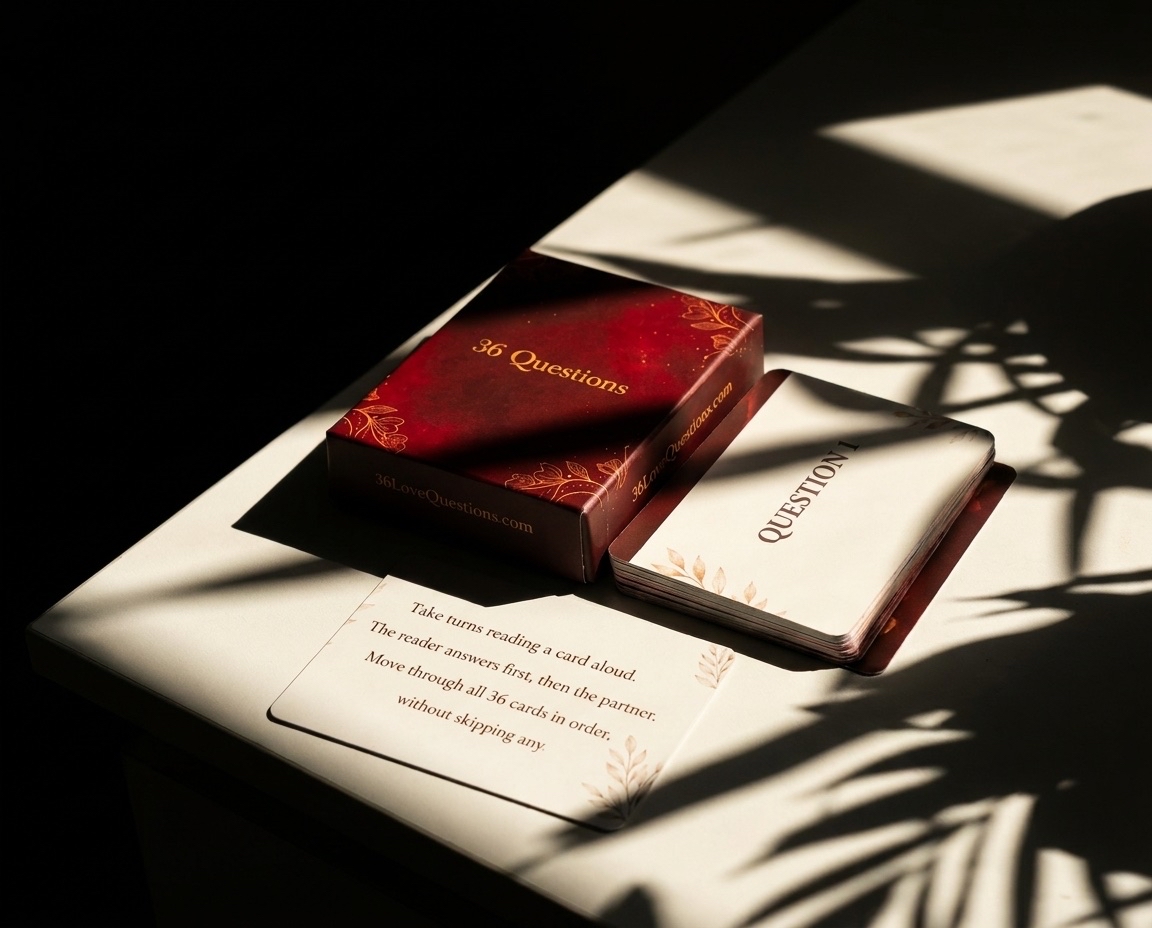
Set III is where the closeness effect actually happens. By now you've been talking honestly for forty minutes and the form starts to do its work.
25. Make three true "we" statements each. For instance, "We are both in this room feeling…" Restart of the "we" thread from #8. Notice what each of you reaches for.
26. Complete this sentence: "I wish I had someone with whom I could share…" A loneliness question. Almost never answered glibly.
27. If you were going to become a close friend with your partner, please share what would be important for them to know. A user manual for you.
28. Tell your partner what you like about them; be very honest this time, saying things that you might not say to someone you've just met. Twice as long as you think it should be. That's the right length.
29. Share with your partner an embarrassing moment in your life. Defuses the intensity right when it's needed.
30. When did you last cry in front of another person? By yourself? Reveals how someone holds emotion.
31. Tell your partner something that you like about them already. Like #28, but on a one-thing scale. Don't repeat your #28 answer.
32. What, if anything, is too serious to be joked about? A surprisingly important values question.
33. If you were to die this evening with no opportunity to communicate with anyone, what would you most regret not having told someone? Why haven't you told them yet? One of the heaviest in the deck. Hold the silence.
34. Your house, containing everything you own, catches fire. After saving your loved ones and pets, you have time to safely make a final dash to save any one item. What would it be? Why? A "what do you actually love" question.
35. Of all the people in your family, whose death would you find most disturbing? Why? Brutal but clarifying.
36. Share a personal problem and ask your partner's advice on how he or she might handle it. Also, ask your partner to reflect back to you how you seem to be feeling about the problem you have chosen. The final closure: shared vulnerability and shared listening.
After question 36, set a timer for four minutes and look into each other's eyes without speaking. This part isn't optional. Aron's group treated the eye contact as a separate manipulation, and the famous closeness effect requires it.
If you want a physical version of this list that quietly enforces the order (one card at a time, no scrolling, no phones), it's the deck we make. Otherwise, print this list, fold it once, and put it on the kitchen table tonight.