Questions to Ask Your Partner Before Marriage
Most lists of "questions to ask before marriage" are either too soft (what's your love language?) or too clinical (what's your debt-to-income ratio?). The questions you actually want answered before getting married are somewhere in between, and they fall into a few specific categories.
This is the list we'd give a friend. Categorized, with notes on why each one matters and how to bring it up.
How to use this list

Don't sit down and grill your partner with all of these in one evening. The point isn't to interview each other. It's to make sure that the conversations you'd want to have eventually happen intentionally, before the wedding, rather than as crisis-discoveries five years in.
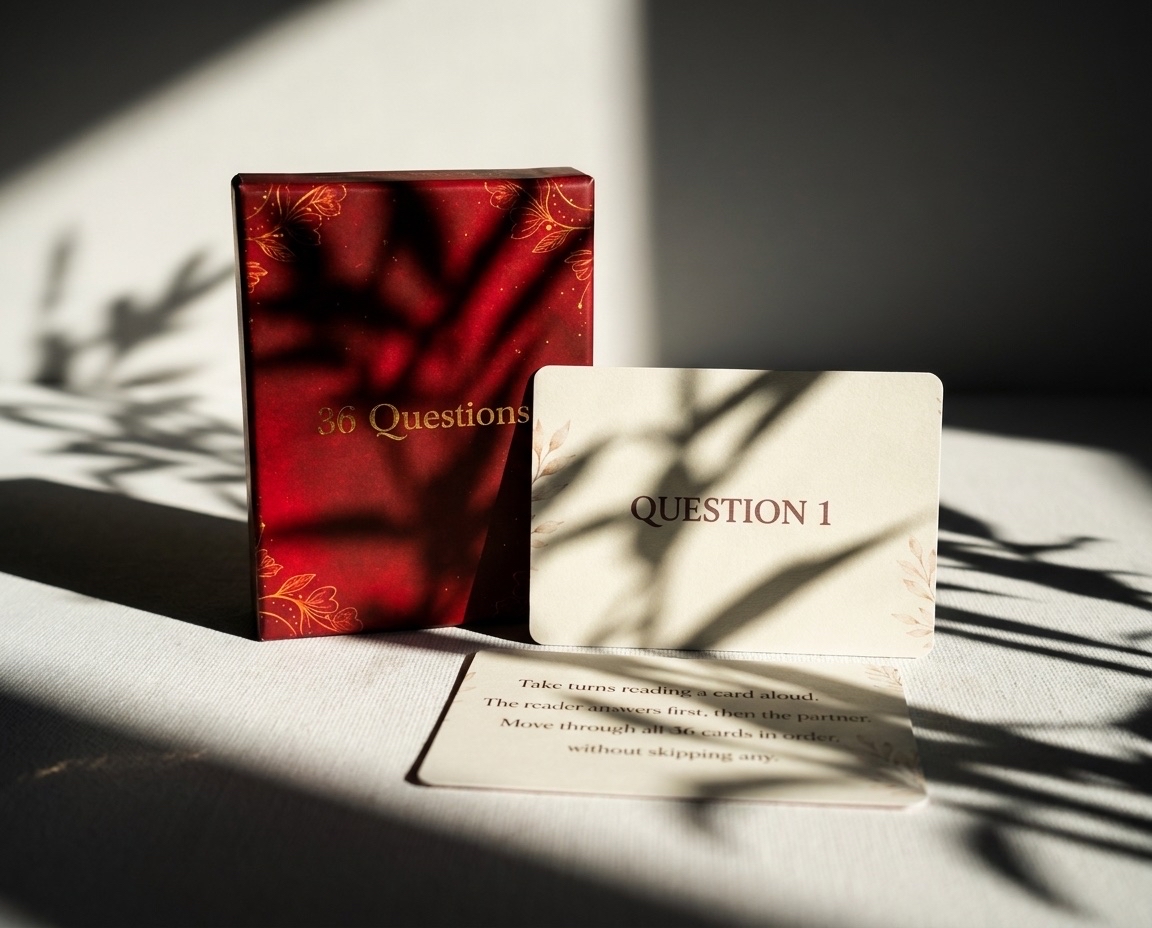
A reasonable cadence: pick a few questions a week, in the months before the wedding. One Sunday morning, one weeknight walk, a Friday dinner. Keep the format the same as the 36 questions: both partners answer the same question, no follow-up questions until both have spoken, no judgment in the moment.
Money
Possibly the most-fought-about and least-talked-about topic in marriages.
- What's your honest financial picture right now? Debts, savings, salary, investments.
- How did your parents talk about money when you were growing up? What did you take from that?
- What's a "small" purchase that doesn't need to be discussed? What's a "big" one that does?
- Joint accounts, separate accounts, or some hybrid: what feels right to you and why?
- Do you want one of us to manage the finances or both of us together?
- What's a financial mistake you've made that you'd want me to know about?
- How do you feel about lending money to family?
- What does retirement look like for you, at what age, what kind of life?
- If we hit a year of financial trouble, what would we cut first?
The most important question in this section is the one about how each of you was raised around money. Most adult money behavior is inherited.
Kids
If you're sure you both want kids or both don't, you still need to have these conversations.
- Do we want kids? How many? What's the timeline?
- If we tried and couldn't have biological kids, what's our plan?
- Who does the night feeds? Who handles sick days? Who handles school admin?
- How were you parented? What do you want to keep, and what do you want to do differently?
- What religious or spiritual practice would we raise children in, if any?
- How will we handle screen time, food, sleep, friendships, dating?
- If our future kid is queer, has a different gender identity than they were assigned, or makes a life choice we wouldn't have, how would each of us handle it?
- What happens if one of us wants kids later and the other no longer does?
The last question is the one most couples avoid and most need to discuss. People change. Pre-discuss the change.
Family
You marry the family, even if you swear you don't.
- How close are you to your parents? Will that change after we marry?
- What does "spending the holidays" look like, ideally? What's non-negotiable for you?
- If your parents needed financial help, what would we do?
- If your parents needed to live with us late in life, what would we do?
- How much do you want our parents involved in our future kids' lives?
- Are there family dynamics I should know about that I haven't seen yet?
- What's a family pattern of yours that you don't want to repeat?
Family questions are often less about answers and more about whether you both have the same level of awareness. Couples in trouble usually have radically different models of how each other's families operate.
Sex and physical intimacy
The hardest category for most couples to discuss directly.
- What does a healthy sex life look like to you in this marriage?
- What's a frequency you'd be unhappy with: too often, too rarely?
- What turns you off, in a relationship-sense, that doesn't get talked about?
- How do we talk about it when one of us isn't in the mood for a long stretch?
- Are there things you'd want to try that you haven't said?
- How do you feel about kink, porn, masturbation as parts of a married sex life?
- What's your honest history we should both know about?
These are uncomfortable on the first try. Have them anyway. Couples who can talk about sex directly stay sexually connected over decades.
Conflict and repair
Predictive of marriage durability more than almost any other category.
- How did your parents fight? What did you take from that?
- When you're hurt, do you withdraw or get loud? When I'm hurt, what should I expect from you?
- What's a fair fight to you? What's an unfair one?
- When have you felt most criticized in our relationship so far?
- When have you felt most accepted in our relationship so far?
- What's something you've been wanting to say that's hard?
- Would you go to couples therapy? Under what conditions?
The therapy question is important. The marriages that survive long stretches usually have one or both partners who have at some point said "we should get help with this," and meant it.
Career and ambition
The category that quietly produces the most regret in long marriages.
- What does success look like for you in your career, concretely?
- Are you willing to move for my career? Am I willing to move for yours?
- What's a sacrifice you're not willing to make for either of our careers?
- If one of us became famous (in our field), what would you want from the other?
- If one of us made dramatically more money, how would that change things?
- What does ambition look like for you in 10 years? 20 years?
Long-married couples often discover, twenty years in, that they had radically different models of what each other's career was for. Have it now.
The relationship itself
These are the deeper ones. Use the structure of the 36 questions if you want: both answer, no follow-ups, take turns.
- What about me made you decide you wanted to marry me?
- What's a fear you have about getting married, to me specifically, or to anyone?
- What's a part of yourself you're worried I'll lose patience with over time?
- What's a way you've changed since we got together that I might not have noticed?
- What's something I do that you find genuinely admirable?
- What's something I do that frustrates you that you've never said?
- Where would you want us to be in five years, concretely?
- What scares you about long-term marriage in general?
The last few are the questions most premarital couples skip. Don't.
A premarital protocol
A simple practice for engaged couples: in the months before the wedding, do two things:
- Work through this list, a few questions a week. Treat it as planning, not interrogation.
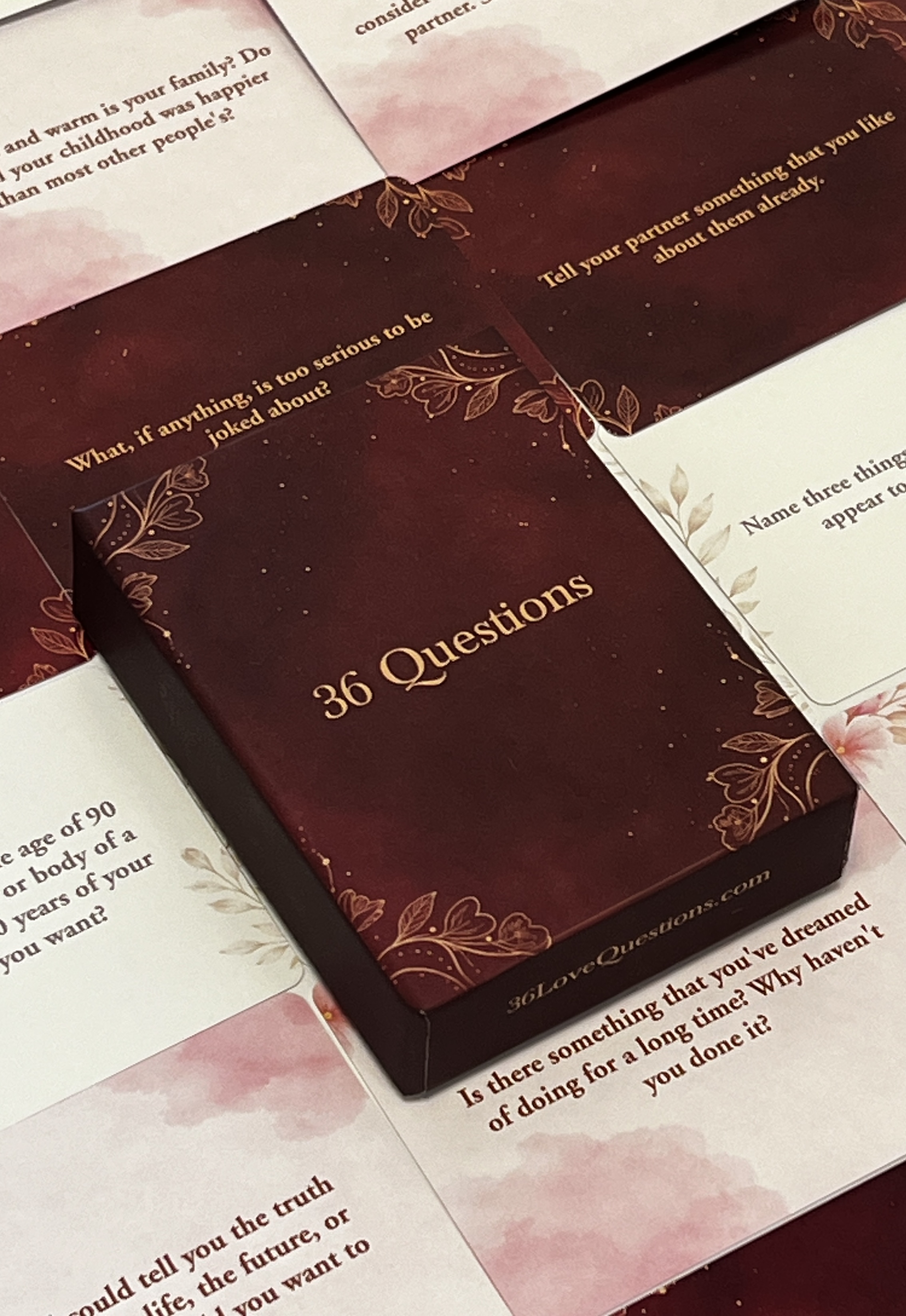
- Do the 36 questions together once. They cover the interior of who you each are, which premarital lists tend to skip in favor of the practical.
Some couples also benefit from a few sessions of premarital counseling, which is structurally similar to this list but with a third party.
The reason these conversations matter is that the things you avoid before the wedding tend to get more expensive to talk about every year afterwards. The wedding is, among other things, a forcing function for honesty. Use it.
If you want a tool that opens up the deeper interior conversations alongside the practical ones, the 36 questions deck is genuinely well suited to engaged couples: many couples we hear from do all 36 the weekend before the wedding.