36 Questions to Fall in Love: The Complete Guide
The "36 questions to fall in love" is one of the most-tried, most-talked-about social experiments of the last thirty years. It's been written up in The New York Times, run as a TED Talk, parodied on sitcoms, used as a real first date by hundreds of thousands of couples, and adapted by therapists into a clinical tool.
This is the practical guide nobody quite writes: what the questions actually do, where the popular version goes wrong, and how to get the experience the original study was designed to create.
What "the 36 questions" actually are
In 1997, the social psychologist Arthur Aron and his collaborators at SUNY Stony Brook published a paper called The Experimental Generation of Interpersonal Closeness in a Laboratory Setting: A Procedural and Some Preliminary Findings. Buried in the methodology was a 36-item list of questions that two strangers would answer together, taking turns, going in order.
The list is split into three sets of twelve. Each set is more personal than the last:
- Set I is warm-up: dinner-guest fantasies, what a "perfect day" looks like, when you last sang to yourself.
- Set II moves into values, memories and self-image: your most treasured memory, the role of love and affection in your life, what you'd do differently in childhood.
- Set III is intimate: telling your partner what you like about them, sharing an embarrassing moment, talking about how you'd feel if your mother died, then making three "we" statements together.
The session ends with four minutes of uninterrupted eye contact, and that part is not optional. Aron treated the eye contact as a separate manipulation. In the published study it was paired with the questions and the combination is what produced the famous closeness effect.
One key pattern associated with the development of a close relationship among peers is sustained, escalating, reciprocal, personal self-disclosure. Aron et al., 1997
Why the questions work (in plain English)
There's no magic in the prompts themselves. The mechanism is escalating reciprocal self-disclosure, a phrase psychologists use because it captures three separate things that have to happen at the same time:
- Escalating. Each question is slightly more personal than the one before. You don't go from "what's a perfect day?" to "describe your most embarrassing moment" in one jump. The escalation keeps the difficulty roughly equal to your tolerance.
- Reciprocal. You both answer the same question. Whatever you reveal, your partner reveals something of equal weight. Vulnerability gets matched, not exploited.
- Self-disclosure. The answers actually have to be real. The questions are constructed so that a fluent, polite non-answer feels obviously hollow.
When all three conditions are met for forty-five minutes, your nervous system updates its model of the other person from "stranger" to "someone who knows me." That update is what we colloquially call closeness.
What people get wrong about it
A few myths are worth dismantling, because they predict whether the exercise will work for you:
Myth 1: It "makes" people fall in love. The 1997 paper never claimed this. The famous Mandy Len Catron NYT essay, which made the questions go viral in 2015, was titled To Fall in Love With Anyone, Do This, but Catron herself was careful: she wrote that she and her partner "chose" to fall in love. The questions don't override compatibility. They reveal it.
Myth 2: They're a hack for a great first date. They are a great first date, for two people who already wanted to be honest. They're a terrible first date if either person is performing.
Myth 3: You can paraphrase or skip questions. The order and wording were tested. Skipping breaks the escalation curve. Re-wording usually means you're avoiding the question.
Myth 4: It only works on strangers. Aron's group has since used the protocol with long-married couples, with classroom partners, with strangers from opposing political parties. The closeness effect replicates almost everywhere two willing adults follow the rules.
How to actually do it (a real protocol)
Most articles about the 36 questions are vague at the practical level. Here's what actually works, distilled from the original procedure and from the thousands of couples who have shared their experience:
- Block 90 minutes, not 45. Plan to overshoot. The first time is always slower than you think.
- Decide in advance who reads first. You'll alternate cards. The reader of a card answers first; the partner answers second. This is from the original protocol and it matters. It ensures the person who chose to introduce the topic also commits to it first.
- Sit facing each other, eye level, no table between you if possible. Phones in another room, not just on silent.
- Don't comment between answers. No "great answer," no follow-up questions, no jokes. Just listen, then take your turn. You can talk about the answers afterwards.
- Do all three sets in one sitting. Splitting it across two evenings cuts the closeness effect roughly in half (this is a finding from Aron's later replications, not just folklore).
- End with the four minutes of eye contact, set a timer, no talking, no smiling-on-purpose. It will feel long. That is the point.
- Debrief together for ten minutes, not about the questions, but about what came up.
What it actually feels like
The most common report is not "I fell in love." It's something more like: "I noticed I was being unusually honest, and so was she, and afterwards I trusted her in a different way."
A few patterns show up over and over in user reports:
- People consistently say the eye contact was the hardest part, harder than any single question.
- The biggest emotional moments tend to land somewhere between question 25 and question 32 (the part of Set III where you describe a recent emotional moment, then talk about loss).
- Couples already in a relationship often report being surprised by what they didn't know about a partner of years.
- Almost nobody finishes the exercise feeling exactly the same about the other person as when they started.
The version we make
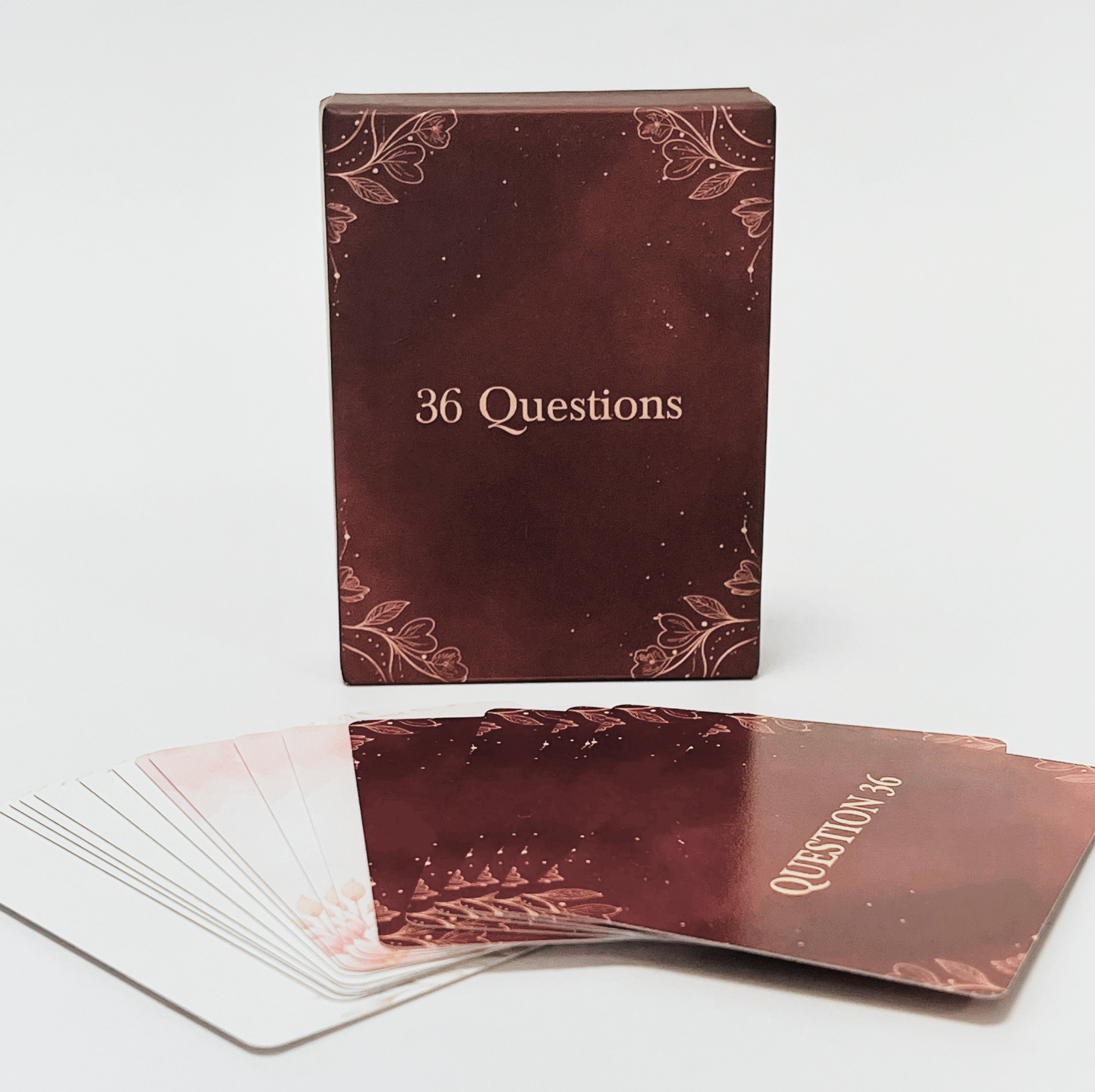
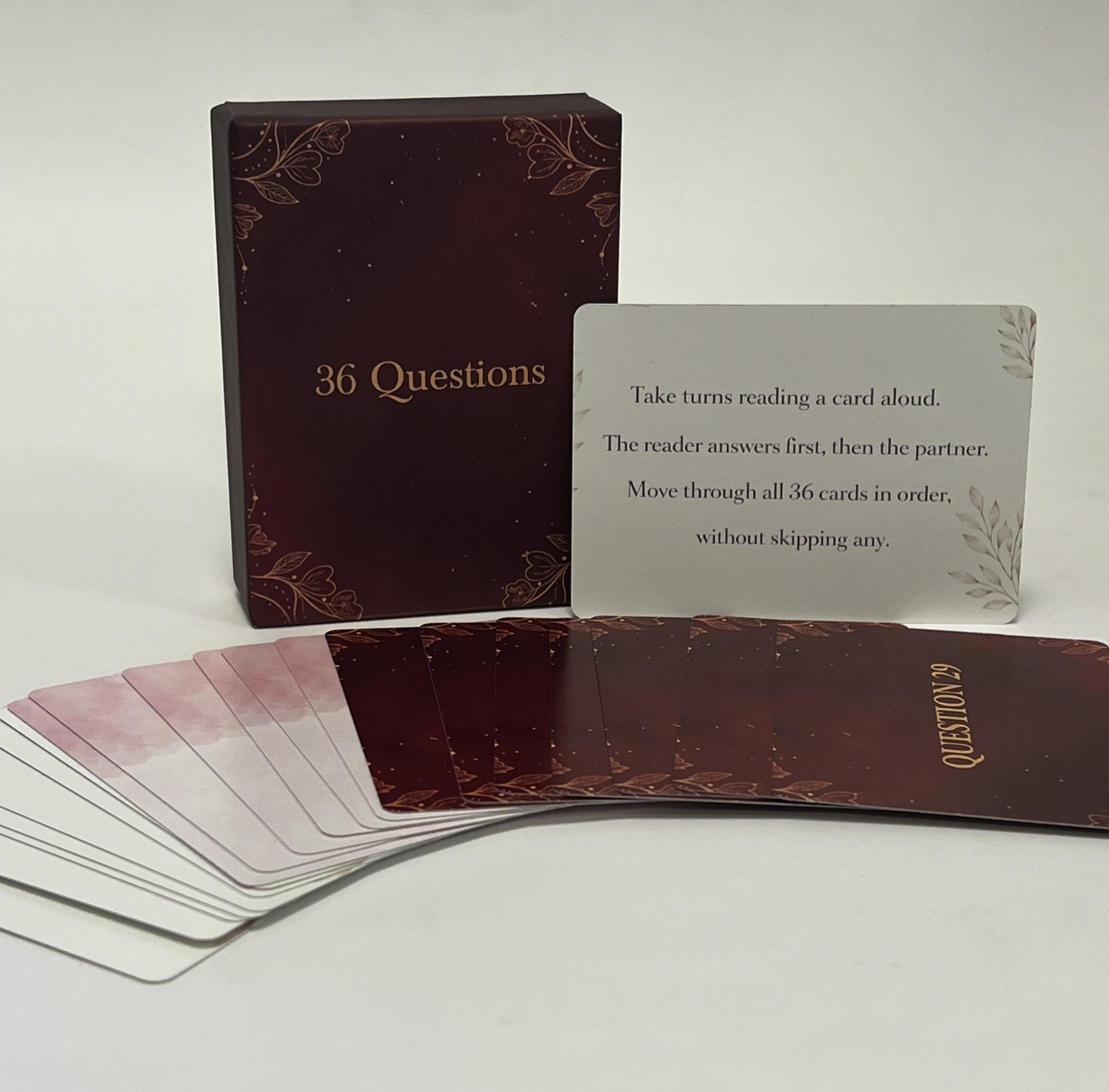
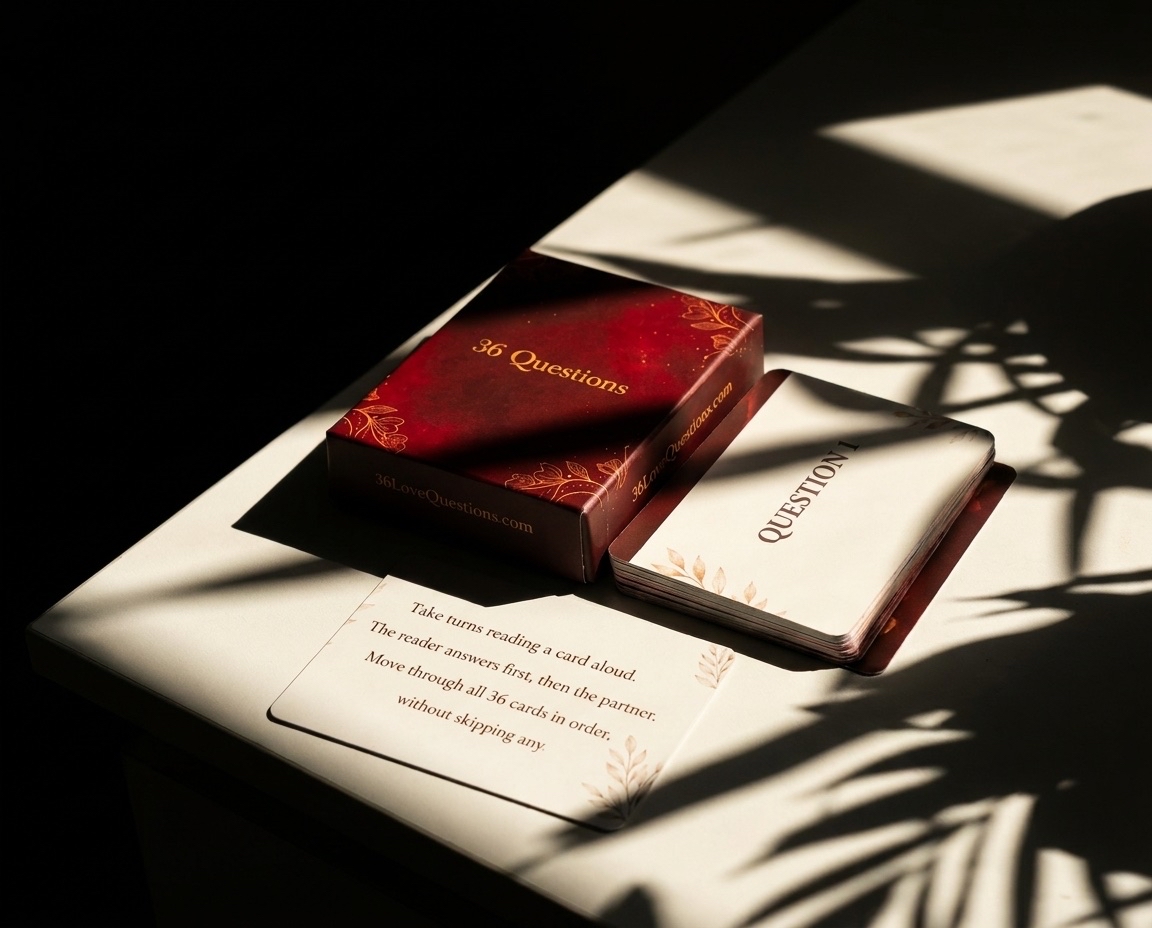
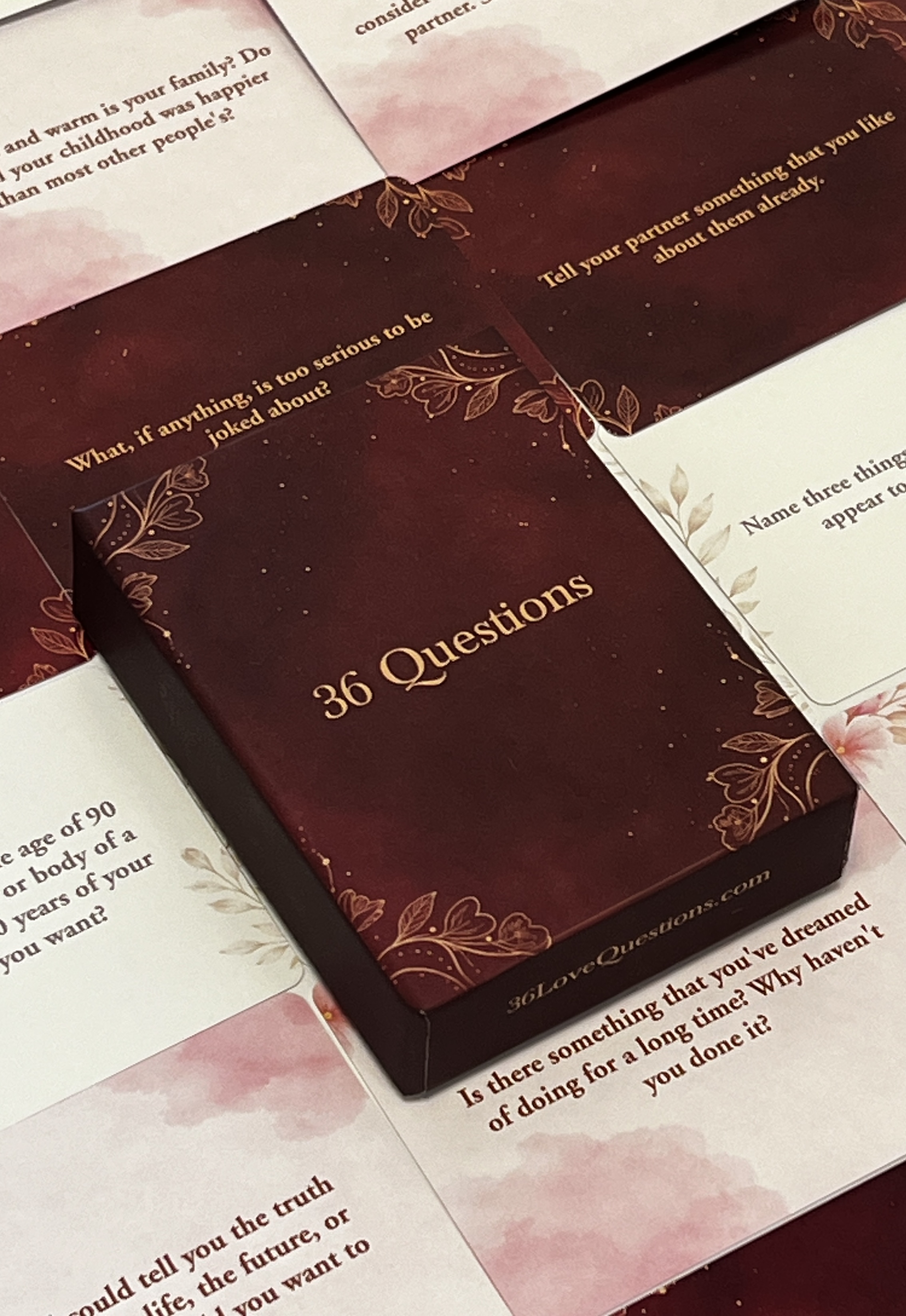
After hundreds of conversations with couples doing the questions over kitchen tables, on first dates, on anniversaries, we made a card-deck version that quietly enforces the rules. Each card is a question; you take turns drawing the top card. There's a separate instructions card with the protocol on it. No phones, no scrolling, no "wait, what was the next one?"
That structure is the entire reason we made it: the questions only work when you respect the form.
What to read next
If you're new to all of this, start with the full list of questions with commentary. If you're skeptical, read the science behind the 36 questions. If you're planning to do them on a first date, read our first-date playbook. It covers what to say if your date doesn't take it seriously.
The 36 questions are not a love spell. They're a structure for becoming briefly, reciprocally honest with another person, and that, it turns out, is more powerful than most things people do on dates.
Frequently asked questions
Do the 36 questions really make you fall in love?
No, and the original 1997 study never claimed they did. The questions reliably create a strong feeling of closeness between two willing partners. Whether that closeness becomes love depends on compatibility and choice.
How long do the 36 questions take?
Plan for 60 to 90 minutes for the questions, plus a four-minute period of sustained eye contact at the end. Most couples take longer than they expect on the first attempt.
Can long-term couples do the 36 questions?
Yes, this is one of the most common uses today. Couples who have been together for years routinely report learning new things about each other and feeling reconnected.