The Science Behind the 36 Questions: Aron's Study, Explained

Almost everyone has heard the headline: "36 questions can make two strangers fall in love." Almost no one has read the paper.
The actual study is more interesting and more measured than the headline. It also has limitations that anyone using the questions in real life should know about. Here's what's actually going on.
What the study tested
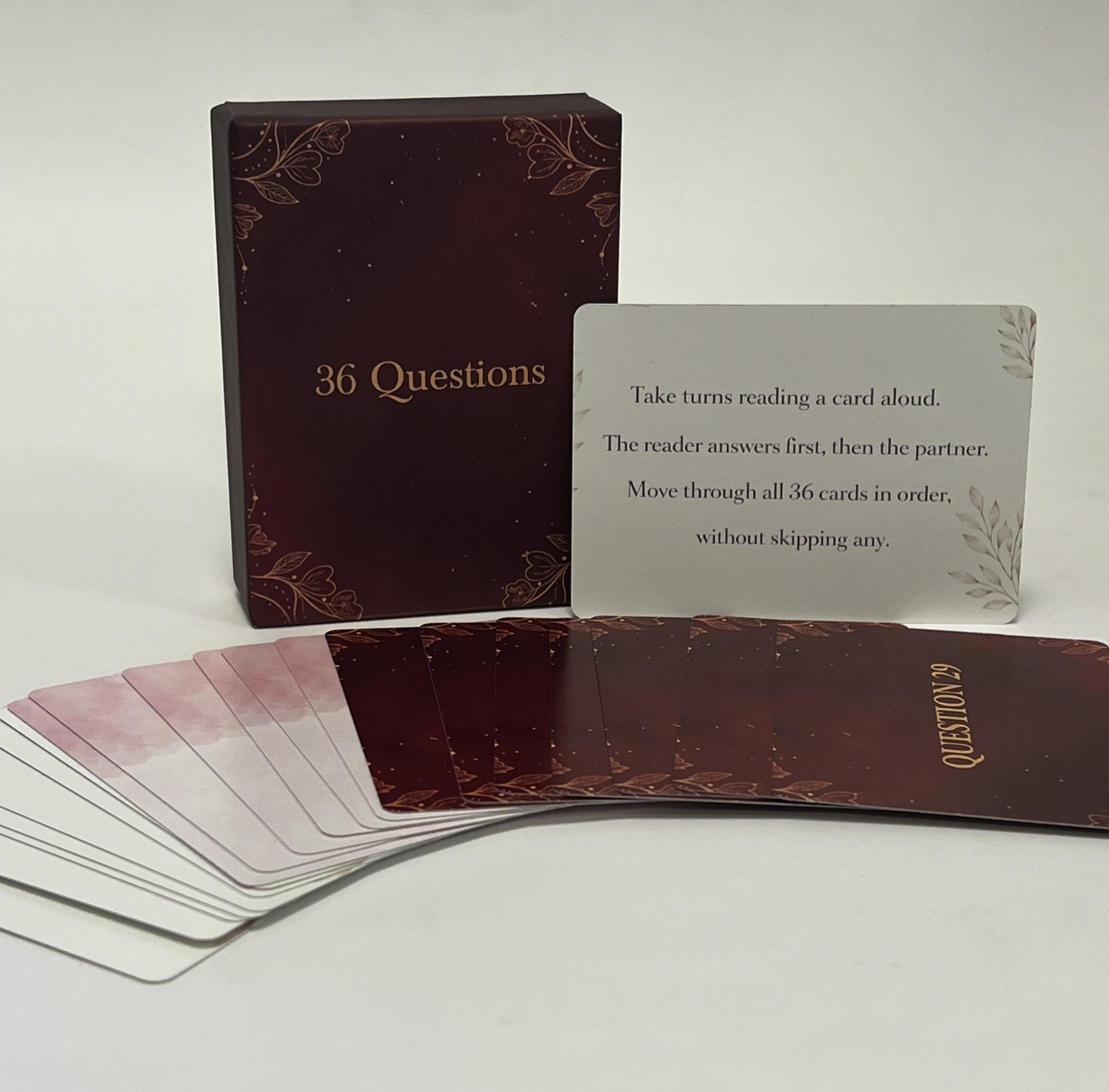
The paper is The Experimental Generation of Interpersonal Closeness in a Laboratory Setting: A Procedural and Some Preliminary Findings by Arthur Aron, Edward Melinat, Elaine Aron, Robert Vallone and Renee Bator, published in 1997 in Personality and Social Psychology Bulletin.
Aron's group was investigating a specific theoretical question: can two strangers be made to feel close to each other on demand? Their hypothesis was that closeness was the product of escalating, reciprocal self-disclosure, a fancy way of saying "you tell me something a little personal, then I tell you something a little personal, and we both keep raising the stakes."
To test this, they designed a 45-minute laboratory procedure. Pairs of strangers were brought into a room and given a packet of questions to answer together, taking turns, going in order. The questions came in three sets of twelve, each set more personal than the last. After 45 minutes, partners filled out a closeness questionnaire (the Inclusion of Other in the Self scale, plus a separate subjective closeness measure).
The control condition used the same procedure, same time, same partners, but with small-talk questions instead. ("How did you celebrate last Halloween?" vs. "What is your most treasured memory?")
What was actually found
The closeness scores in the disclosure condition were significantly higher than in the small-talk condition. By the standards of social psychology, the effect was large, comparable to the closeness people reported with their real friends and family in baseline surveys.
That's the famous result. But three details usually get dropped from the headline:
- The eye contact piece is separate. The four minutes of uninterrupted eye contact was tested as its own manipulation in some conditions, with and without the questions. The headline number is for "questions + eye contact." Without the eye contact, the effect is smaller.
- No one was told to fall in love. Subjects were told they were participating in a study about closeness. The word "love" doesn't appear in the procedure description.
- The "married couple" anecdote is not from the paper. The widely-repeated story that two of Aron's subjects later married is true (they did), but it was one couple, recounted in a follow-up interview, not a study finding.
Why "escalating reciprocal self-disclosure" works

The mechanism Aron was probing is older than his study. It comes out of work by Sidney Jourard in the 1960s and Irwin Altman in the 1970s on self-disclosure theory, which proposed that intimacy develops through a stepwise process of revealing yourself to someone who reveals themselves back at roughly the same depth.
Three things have to happen at once for it to work:
- Escalation. Each disclosure is slightly riskier than the last. Too big a jump and people withdraw; too small and nothing changes. The 36 questions are basically a hand-tuned escalation curve.
- Reciprocity. Whatever you reveal, your partner reveals something of equal weight, and vice versa. This is the part that distinguishes intimate disclosure from over-sharing.
- Active listening. The listener has to receive the disclosure as significant, not deflect it. The eye contact at the end is partly a listening signal.
When these three conditions are met for forty-five minutes, your nervous system updates its prior on the other person from "stranger" to "someone who knows me." That update is what the closeness questionnaire is measuring.
What the popular version gets wrong
Two big myths and one small one:
Myth 1: "The questions make you fall in love." The original paper does not claim this. Mandy Len Catron's 2015 NYT essay, which made the questions go viral, was carefully phrased: she and her partner chose to fall in love. The questions reveal compatibility. They don't manufacture it.
Myth 2: "Any two strangers can do this and it works." The replication record is good but not perfect. The effect is much weaker if either partner is performing for the other, refuses to take the harder questions seriously, or breaks the reciprocity by asking the partner to disclose without disclosing themselves. Bad-faith subjects break the procedure.
Myth 3: "It's about asking smart questions." The questions matter much less than the structure. Most of the closeness effect comes from the escalation curve, the reciprocity, and the eye contact, not from any single brilliant prompt. You could probably substitute a different list of 36 questions in the same shape and get a similar result.
What the science says about long-term couples
Aron's group has continued to study the procedure since 1997. A few replication and extension findings worth knowing:
- The closeness effect replicates with people who are already in relationships. Long-term partners who do the 36 questions report a measurable boost in felt closeness, though smaller than the strangers-meeting-strangers effect.
- Doing the questions while doing something physiologically arousing (e.g., on a fast-walking date) magnifies the closeness effect. Aron's broader work on the "self-expansion" model predicts this.
- The benefits are short-lived without follow-up. A single session produces a real but fading boost. Couples who repeat the practice, or use it as a launching pad for a different conversation habit, see longer-lasting effects.
- The protocol does not work as a substitute for therapy for couples in distress. It's a closeness amplifier, not a conflict resolver.
The honest bottom line
The 36 questions are a real psychological tool with real, measurable effects on subjective closeness. They are not a love potion. They work because they enforce a specific kind of conversation (escalating, reciprocal, attentive) that almost never happens spontaneously in modern life.
The reason we made a physical card version is exactly this: phones break the reciprocity, scrolling breaks the escalation, multitasking breaks the listening. A deck of cards on a kitchen table fixes all three for an evening.
What the study technically proved (and what it didn't)
It's worth being precise about the original finding, because the popular version has drifted from the careful one.
What the 1997 study actually demonstrated:
- Pairs of strangers who completed the 36 questions together scored higher on the Inclusion of Other in the Self scale immediately after, compared to a control condition that did small-talk for the same length of time.
- The effect was robust across same-sex and opposite-sex pairings.
- The effect held whether participants were told to expect that they'd "like" their partner or not: the structure did the work, not the framing.
- A subset of pairs reported continued contact months later, but the study was never designed to measure long-term outcomes.
What the study did not prove:
- It did not prove the questions cause romantic love. Aron's group has been clear about this in subsequent interviews: the questions produce closeness, which can become attraction in the right conditions but is not the same thing.
- It did not prove that any single question is more potent than the others. The whole point is the escalating sequence; isolating individual questions misses the mechanism.
- It did not prove the four-minute eye contact (which actually came from a different Aron paper) belongs in the protocol, but it does in practice.
If you want to dig into the original research, the citation is Aron, Melinat, Aron, Vallone, & Bator (1997), Personality and Social Psychology Bulletin, vol. 23, issue 4. The full paper is publicly available; it's a short, readable piece of methods writing.
Frequently asked questions
Is the 36 questions study real science?
Yes. It was published in Personality and Social Psychology Bulletin in 1997 by Arthur Aron and colleagues, has been replicated multiple times, and is taught in introductory social psychology courses.
What is the difference between the questions and the eye contact?
They are two separate manipulations. The full closeness effect was reported for the questions plus four minutes of sustained eye contact. The questions alone produce a smaller effect.
Do the 36 questions work over text or video?
There is limited research on remote use. The closeness effect is plausibly weaker over text (the eye contact component is hard to replicate), but couples doing the questions over video do report real closeness gains.