How to Play the 36 Questions Card Game (the Right Way)
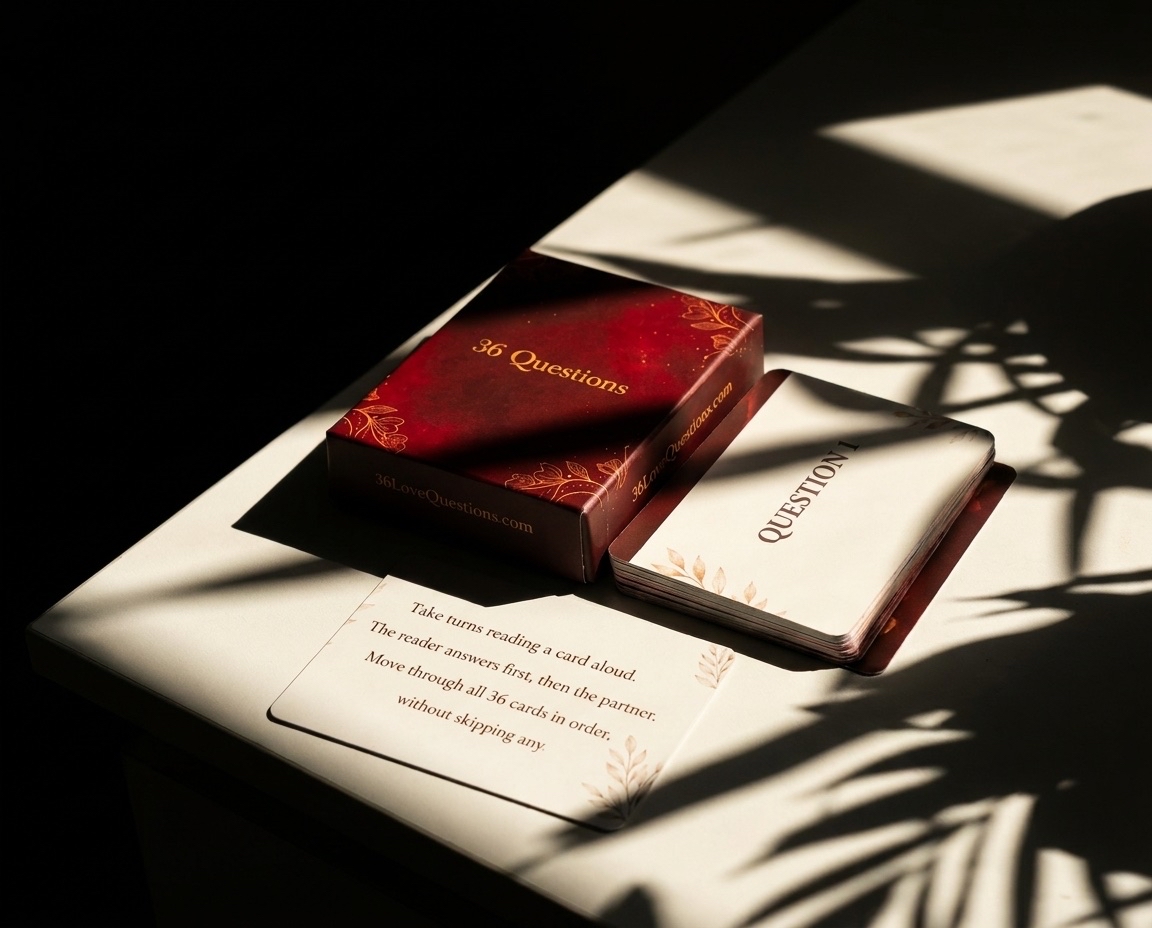
The 36 questions card game has the simplest rules of any deck game in your house. There is no scoring, no winning, no shuffling, no draw pile. You take cards in order and answer them out loud.
That simplicity hides a few moves that matter a great deal. This is the practical playbook: what we tell people who write in and ask "are we doing it right?"
Before you start
Block the time. 90 minutes minimum. The questions take roughly 60–75; the eye contact is 4; you'll want some time to talk afterwards without watching the clock. If you've only got 45 minutes, do it on a different night.
Pick the right room. Somewhere comfortable, neither of you sitting "above" the other (avoid couch + floor). Two chairs facing each other is ideal. A kitchen table with two facing seats works well. Bed is fine if it's the only quiet place; just sit up.
Phones in another room. Not on silent on the table. Not face-down on the table. Another room. The cost of a phone glance is much higher than people think. It doesn't just interrupt; it tells the other person their answer is competing for your attention.
Have something to drink. Tea, wine, water: doesn't matter, just something. The questions are easier when your hands have something to do between cards.
Don't pre-read the questions. This is the single most common mistake. If you've already seen what's coming, the escalation curve flattens and the surprise of being asked something hard goes away.
The setup
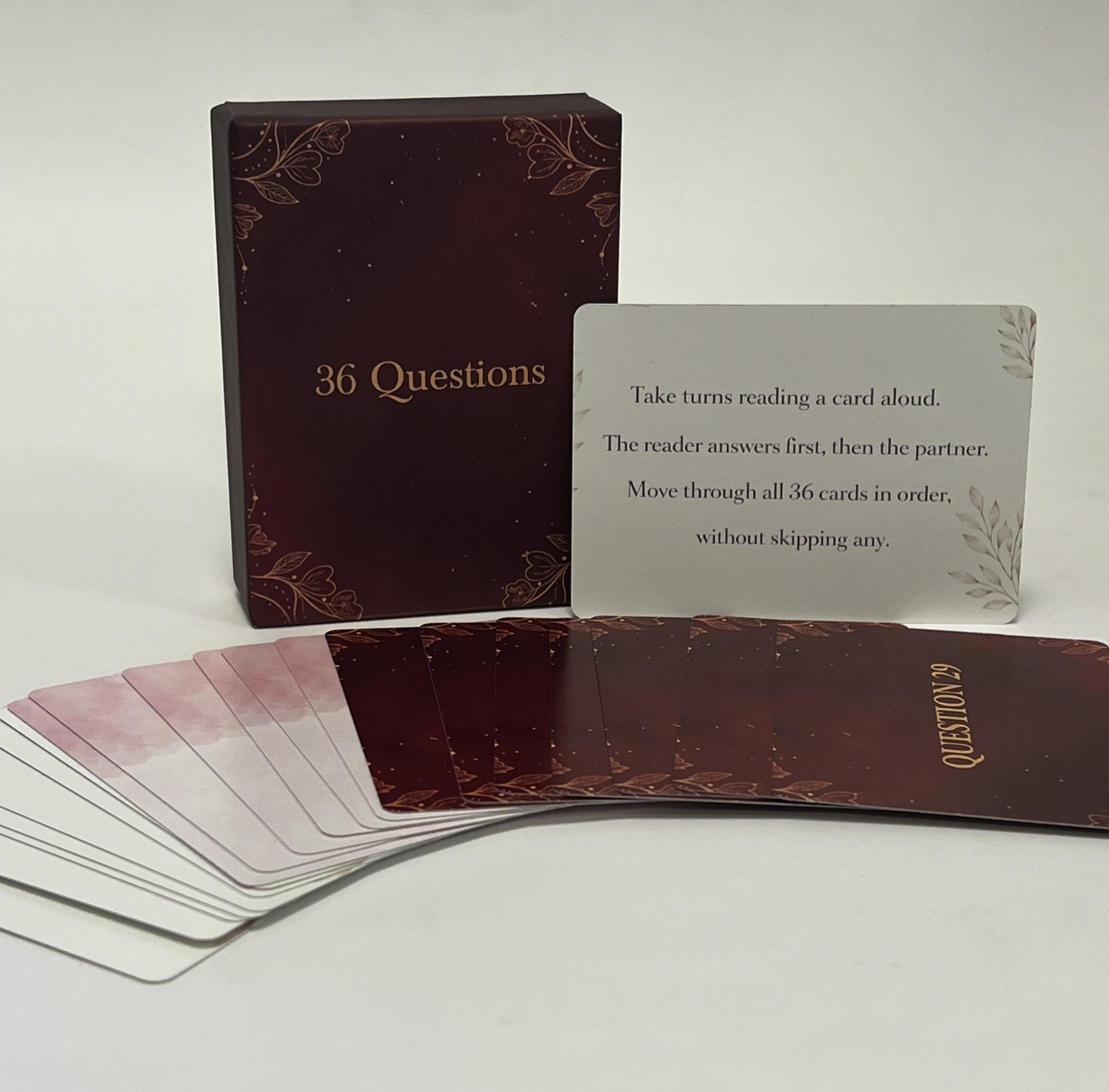
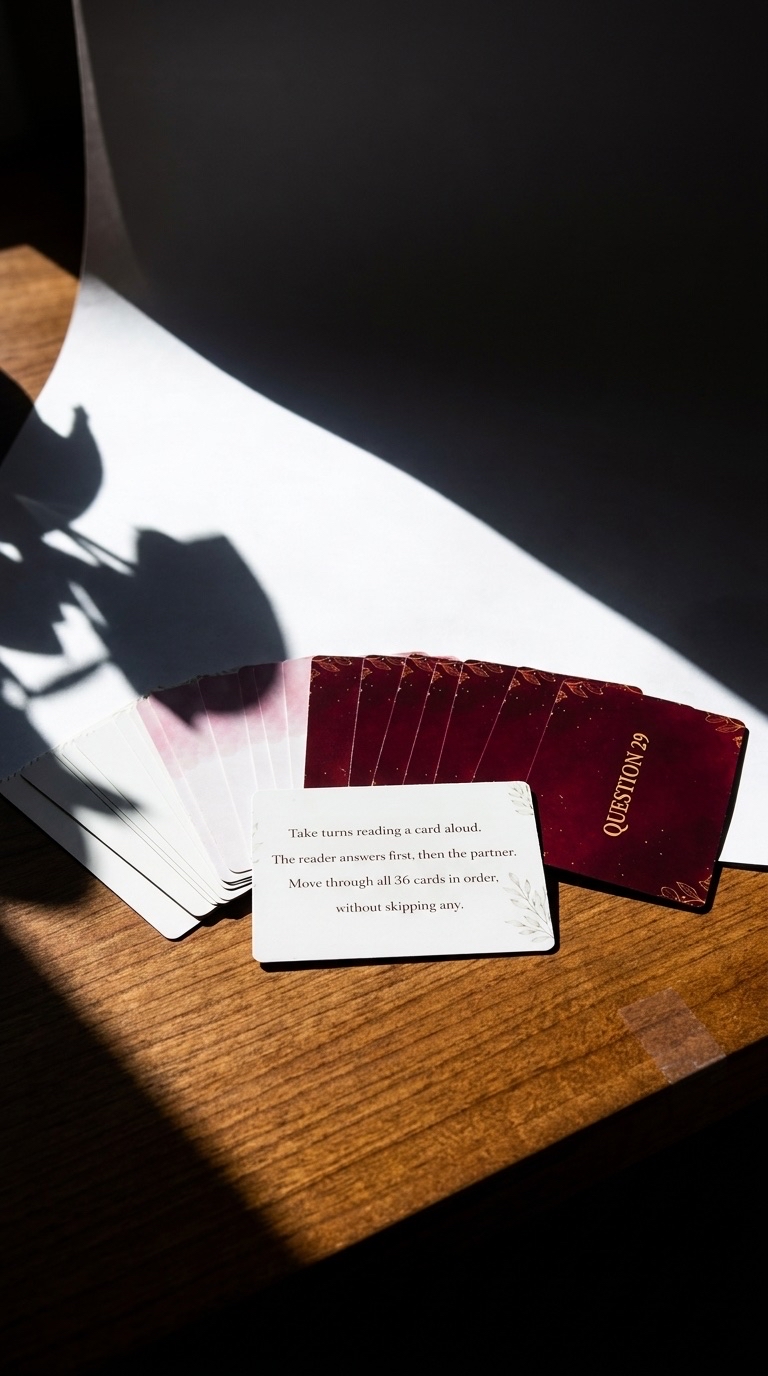
Place the deck face-down between you. Put the instructions card face-up on top.
Decide who reads the first card. From then on, you alternate readers: they read one card, you read the next.
The reader of a card answers first, then the partner answers. This is from the original procedure and it's not arbitrary: it puts the person who chose to introduce the topic in the position of committing to it first. It also distributes the awkwardness evenly across both of you.
During the questions
A few rules that look obvious until you're in the middle of question 18:
Don't comment between answers. No "great answer." No "oh, mine's similar." No follow-up questions. Just listen, then take your turn. Comments between answers shift the dynamic into "interview" mode, which kills disclosure.
Don't paraphrase the questions. If a card says "what is your most treasured memory," don't soften it to "like, what's a happy memory you have?" The wording is precise. Read it as written.
Don't skip. Even if a question feels off (say, you've already discussed the dinner-guest one on a previous date), read it and answer it again anyway. The order matters more than the freshness.
Take your time. Pauses are fine. Pauses are good. The deck is not a quiz show. The longest pause we've seen on Question 18 was 90 seconds. The couple is still together.
Match depth. This is the most important rule and the one nobody teaches. Whatever depth your partner answered at, match it. If they gave you a one-paragraph honest answer, give them a one-paragraph honest answer back. If they gave you a one-line joke, you can either match the joke or, gently, answer at the depth the question is asking for, and let them re-attempt.
One pass, no re-reads. When the card is done, place it in a discard pile face-down. Don't go back and re-read.
At the bridge between sets
After Set I (cards 1–12), most couples want to take a short break. Don't. The closeness curve flattens if you stop. If you absolutely need a moment, stand up and stretch, but don't leave the room.
After Set II (cards 13–24), similar: push through into Set III. The biggest jump in subjective closeness in the original study happened during Set III, and the curve only works if you arrive there warmed up.
Set III specifically
Set III is where the closeness effect actually gets generated. A few notes specific to these last twelve cards:
Card 28 ("Tell your partner what you like about them; be very honest…") is twice as long as people expect. Plan to spend three or four minutes per person on this one. Don't rush it.
Card 29 ("Share an embarrassing moment") is intentionally placed right after the heavy ones. Lean into the relief. Laughter at #29 is part of how the procedure is supposed to work.
Card 33 ("If you were to die this evening…") is the heaviest card in the deck. Hold the silence after it. Don't try to lighten it.
Card 36 is a partner exercise: you ask each other about a personal problem. This is the only card where you spend longer than a couple of minutes with the same prompt. Plan for 8–12 minutes total.
The eye contact
After Card 36, set a timer for four minutes. Sit facing each other, eye level. Look into each other's eyes without speaking and without trying to communicate anything in particular.
It will feel long. The first 30 seconds are awkward; minute two is the hardest; minute three softens; minute four is calm. This pattern is consistent across almost everyone we've heard from.
A few rules for the eye contact:
- No talking. Not even whispering.
- No deliberate smiling. Smile if it happens; don't perform it.
- No phones, even glancing for the timer. Use a kitchen timer or a wall clock.
- Don't break eye contact for the full four minutes. Blinking is fine.
When the timer goes off, you can say something. Most couples don't immediately. That's fine.
Afterwards
Most couples want to debrief afterwards. Talk about what came up, not "rate the questions," but the actual content. The questions are an opening; the conversation that follows is the relationship.
A useful follow-up question that isn't on any card: what's something you almost said but didn't?
That one alone is worth the price of the deck.
A note on doing this twice
You can do the 36 questions more than once. The closeness effect is smaller the second time, but two things get better: the eye contact gets easier, and the depth of answers increases, since you have more to work with the second time.
A reasonable cadence for couples who like the practice is once a year, on or around an anniversary. A reasonable cadence for couples in a rough patch is once a month for three months.
A short list of things that quietly ruin the night
Things that won't kill the experience but reliably take a chunk out of it:
- Doing it after a heavy meal. A plate of pasta and a second glass of wine sound nice and then everyone gets sleepy somewhere around card 19. Eat lightly beforehand or eat properly after.
- Doing it in the room you fight in. If your kitchen table is where the bills get paid and the school forms get argued about, that table will subtly drag the conversation toward grievance. Move rooms.
- Letting one person be the "host." The questions only work if both of you are in the same chair, metaphorically. If one person is reading every card, pouring every drink, and steering every transition, the other person is on a date with the host, not with their partner.
- Skipping the eye contact because it sounds corny. It is corny. It also does about a third of the work of the entire protocol. Set the timer.
- Talking about it the next morning at breakfast. Let it sit. The closeness curve is supposed to be a little mysterious for a day or two; debriefing it immediately flattens it.
If you want a deck that lives somewhere visible enough that you actually do this, ours is here. If you already have the deck, you have everything you need to do this tonight.
Frequently asked questions
Do you have to do all 36 questions in one sitting?
Yes. The closeness effect depends on the escalating curve, and splitting the session across two evenings cuts the effect roughly in half. Plan for 90 minutes.
What if a question feels too personal?
Answer at whatever depth feels honest to you. The protocol asks you to read every card and attempt every answer; it does not require you to disclose more than you're comfortable with.
Can three or more people play?
The original protocol is designed for two. The closeness effect is a two-person phenomenon: group versions exist but they're a different exercise.