Reconnecting After Kids: Date Night for New Parents

Almost every new-parent relationship goes through a stretch where the two adults stop being a couple and start being a co-CEO partnership running an emergency. The transactions are constant. The conversation is logistics. The eye contact is over a baby's head.
This is normal and it doesn't have to last. Below is the practical playbook: what actually works for couples in the first few years of a child's life when they want to reconnect but the obvious solutions ("plan a date night") feel insurmountable.
Why standard date-night advice fails new parents
The standard advice ("plan a date night, get a sitter, go to a restaurant") fails for new parents for predictable reasons:
- Logistics dominate. By the time you've planned the sitter, you're too tired to enjoy the date.
- You spend the date talking about the kid. This is fine and also doesn't reconnect you as adults.
- You're physically tired. Two glasses of wine and you're falling asleep at the table.
- The "special occasion" framing makes the date carry too much weight. When date night feels Important, both of you tense up.
The better approach is to lower the activation energy until reconnection becomes possible inside the life you already have, not in some future calmer life that won't arrive for a year or two.
The 30-minute reconnect
If you have one bandwidth for change in your week, this is the move.
After the kid is asleep, sit down with your partner (same room, no screens) for 30 minutes. Not for a "date." Not for a structured talk. Just to be in the same room without the kid awake, without the dishwasher running, without one of you on a phone.
Two rules:
- No phones in the room. Yes, even the monitor: keep it on, keep the volume up, in another room.
- No problem-solving. No "we should figure out the daycare situation." Logistics get talked about during the day.
The first ten minutes will feel weird. You'll both want to pick up your phones. Don't. The next twenty are when something happens: sometimes you'll talk, sometimes you'll just sit there together, sometimes you'll go to bed early. All three count.
Three nights a week of this, for a month, dramatically changes the felt closeness in a new-parent relationship. We've heard it back from parents over and over.
Use a small ritual to mark the transition

The biggest psychological barrier for new parents is transitioning out of parent-mode and into partner-mode. The brain doesn't switch on its own.
A small ritual that signals "the parent shift is over" makes the switch easier. Examples that work:
- One specific drink that you only have after the kid is down.
- A change of room: move from the kitchen to the living room.
- One specific song you put on after the bedtime routine.
- A quick five-minute walk around the block.
- A specific candle you light only after kid bedtime.
Doesn't matter which. What matters is the ritual is consistent and means we are now adults again.
Date night that actually works for new parents
When you can manage a real date night (which is harder than it sounds with young kids), a few specific structures work much better than the generic restaurant date:
- Earlier, not later. A 5:30pm reservation while the sitter handles bath and bedtime is much better than 8pm. You'll be present.
- Walk, then sit. Walking is the lowest-friction format for tired parents to actually have a real conversation. Walk to the restaurant if you can.
- A bar, not a two-top. Bar seating is more conversational, less "performance of date night."
- Skip the multi-course menu. Two courses, leave by 7:30pm, go home and watch one episode of something together. Don't push the date past your real bandwidth.
- Don't talk about the kid for the first hour. It will be hard. Try anyway. Plenty of life happens to both of you outside of the child.
When you only have an hour: the two-question dinner
For weeks where a real date night is impossible, the two-question dinner is the highest-leverage practice.
At dinner one night a week (after the kid is down or in the high chair), each of you asks the other one question, but it has to be a question you've never asked your partner before. No work or kid questions allowed.
We have a long list in our conversation starters post. A few that work especially well in the new-parent phase:
- What's something about you that's changed in the last year that I might not have noticed?
- What's a small thing you used to do for yourself that you've stopped doing?
- Who's a friend of yours I should make sure to stay in touch with?
- What's something you'd want to do for yourself this year if we could carve out the time?
Two questions per dinner, three or four times a week. Cumulatively, this rebuilds the conversation lane that small kids tend to close.
When you have a real window: do the 36 questions
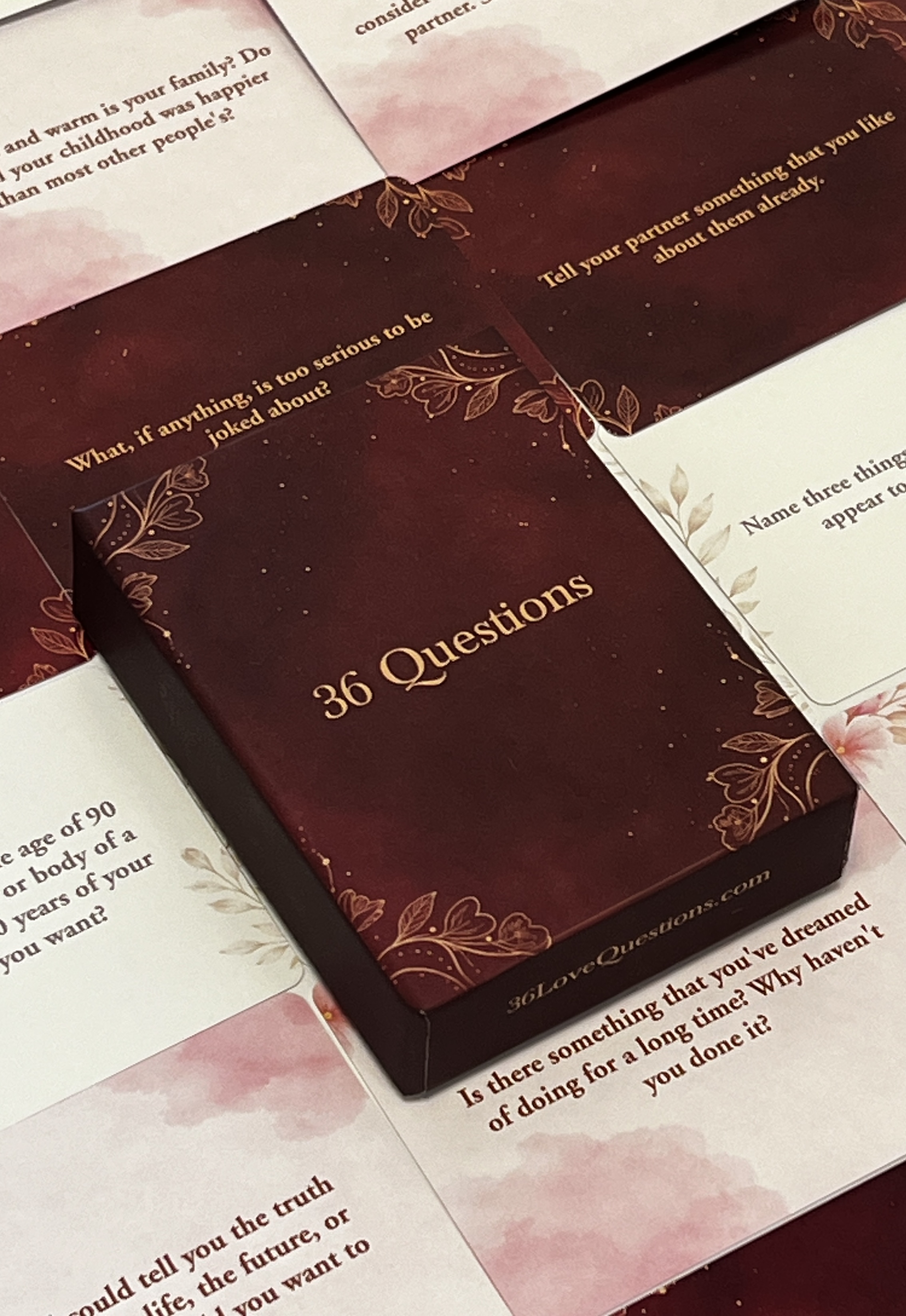
If you can find a real 90-minute block (a sitter on a Friday night, grandparents have the kid for a weekend, the baby is at a sleepover by 18 months in), do all 36 questions in one sitting. Full guide here.
This is one of the most-reported-back things we hear from new parents. The structured 90-minute format does in one evening what a year of distracted dinners can't: it forces a deep update on each other after a year (or two, or three) of being mostly co-parents.
Notes specifically for new parents:
- Eat first. Don't try to do the 36 questions hungry.
- Skip Card 35 if either of you has had a recent loss in the family. New parenthood is enough emotional load.
- Take the eye contact part seriously. It's the hardest to make space for and the most reliably moving.
- Plan to go to bed afterwards. Don't watch a show. The closeness boost is fragile and TV will dissolve it.
The deck is here if you want a physical version. The list is here if you don't.
A few things specific to the early-baby phase
For couples in the first year specifically:
- Touch matters more than conversation. A hand on a shoulder, a back rub, sharing the couch: small physical touch in the first year is more closeness-producing than conversations you're too tired to have.
- Trade off the "good shifts" deliberately. If one of you always gets the night feed and the other always gets the morning, neither of you sees each other awake. Trade so you actually overlap consciously sometimes.
- Outsource one thing. A cleaner once a month, takeout twice a week, grocery delivery: the outsourced thing buys back time for being a couple. The math is real.
- Don't compare yourselves to pre-baby couples. Your relationship will look different for two years. That's normal. The closeness comes back.
When it's been longer
For couples whose youngest is past 4 or 5, the early-parent intensity has usually receded but the habits of relating only as co-parents often haven't. The practical move is to consciously rebuild the partner-relationship even when the parenting has gotten easier.
A reasonable starter sequence:
- Week 1: install the 30-minute reconnect, three nights a week.
- Week 2: add the two-question dinner, twice a week.
- Month 2: do the 36 questions on a Friday night with a sitter.
- Month 3: book a one-night hotel within an hour of home.
That sequence rebuilds the partner-relationship in roughly a quarter, in our experience. The kid doesn't lose anything; the parents get each other back.
The marriage that survived early parenthood is the one that quietly carved out small windows of being a couple again. The windows can be very small. They just have to be real.