36 Questions for Long-Distance Relationships: How to Do Them Apart
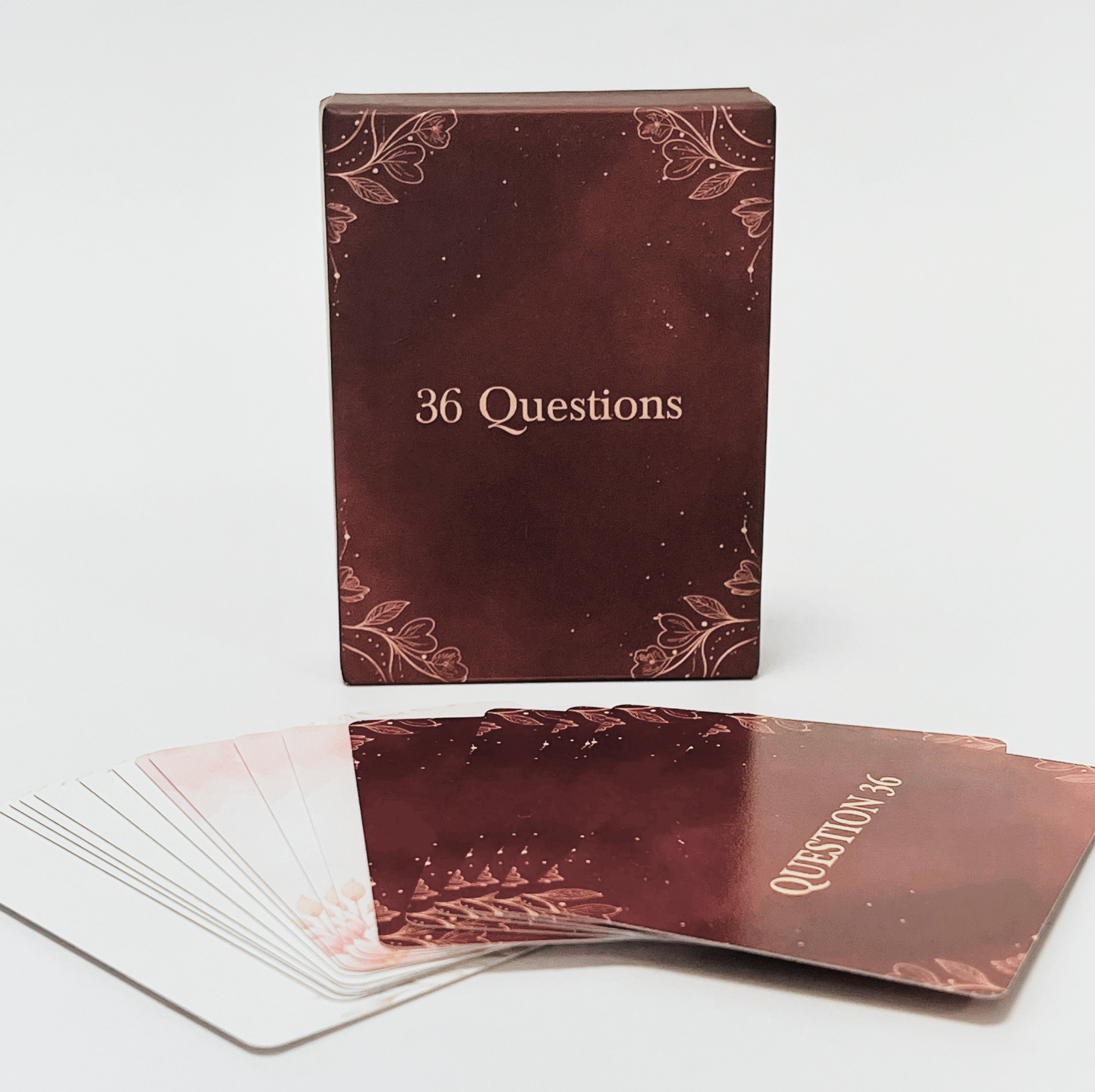
Long-distance partners write to us about the 36 questions a lot. The most common version of the question is: can we do this over video, or are we wasting our time without being in the same room?
Honest answer: you can absolutely do this over video. The closeness effect is smaller than in person (the four-minute eye contact in particular doesn't translate perfectly), but the gain is large enough to be worth a Sunday evening, especially if you don't see each other often.
Here's how to make it actually work.
Picking the right night
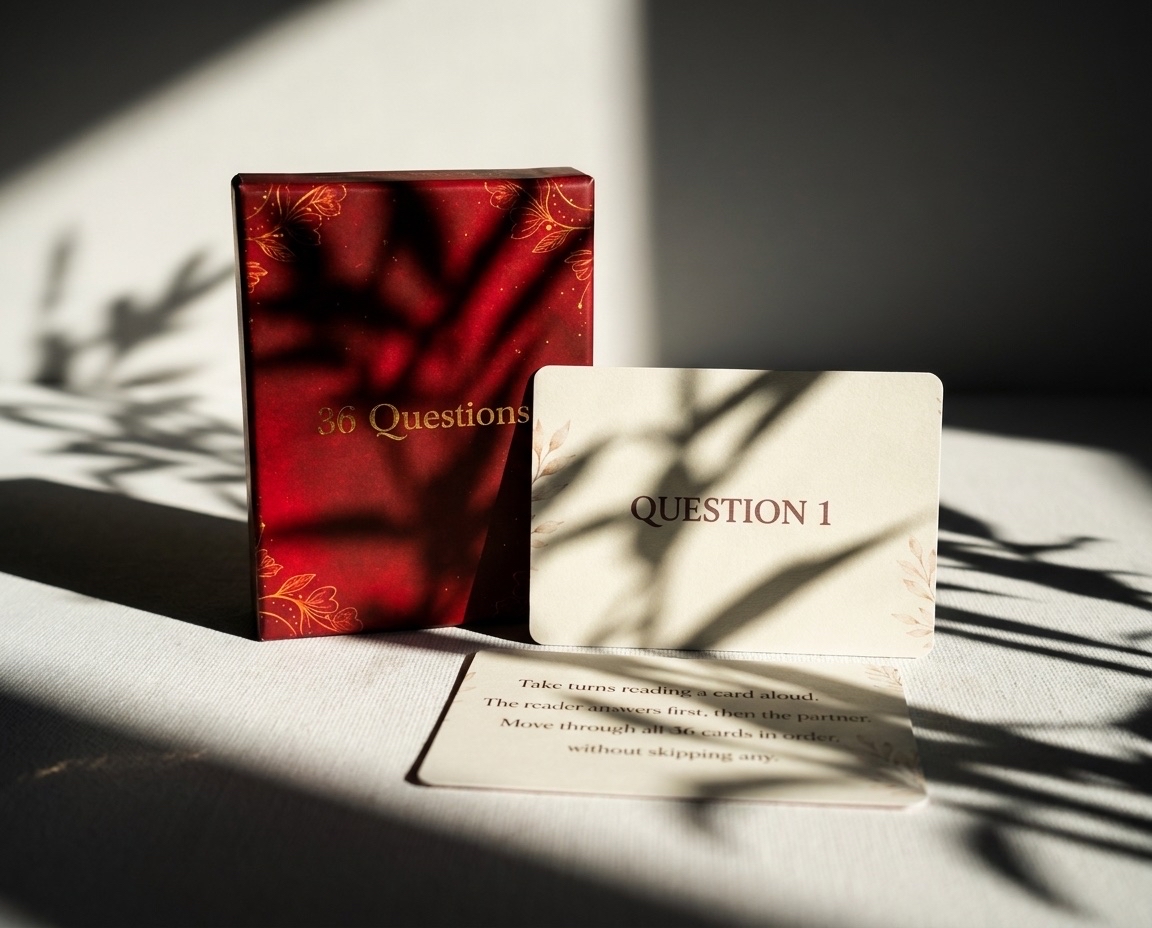
Long-distance couples have to do something co-located couples don't: schedule. The questions don't work as a "let's see if we have time after dinner." Pick a night, block 90 minutes on both calendars, and treat it like a flight you can't reschedule.
Some practical notes:
- Pick a window that's reasonable on both ends. If one of you is doing this at 10pm and the other at 2pm, the energy will be mismatched and the questions will feel weird. Find an overlap that works for both.
- No back-to-back meetings. Block 30 minutes before and after. The disclosure curve doesn't survive a 6:30 work call followed by a 7:00 "okay let's start."
- Tell each other what's open behind you. "I have a wedding tomorrow at 9am, so I'm going to be a little tired" is much better information than discovering it mid-question.
Tech setup
A few small choices that genuinely matter:
- Use video, not voice. The eye-contact piece is partial without seeing each other.
- Use a laptop or tablet, not a phone. Holding a phone for 90 minutes is awful and your partner will see your arm shake.
- Set the camera at eye level. Stack books under the laptop. The illusion of being looked at is worth the dignity hit.
- Use headphones. Built-in laptop speakers cause echo on long calls and you'll subconsciously keep volume low, which kills warmth.
- No second screens. Close every tab. Phones in another room. Long-distance couples are habitual multitaskers on calls. For this, don't.
- Lighting matters. Have a soft light in front of you (not behind). You want your partner to be able to see your face clearly for the eye contact.
How to handle the cards remotely
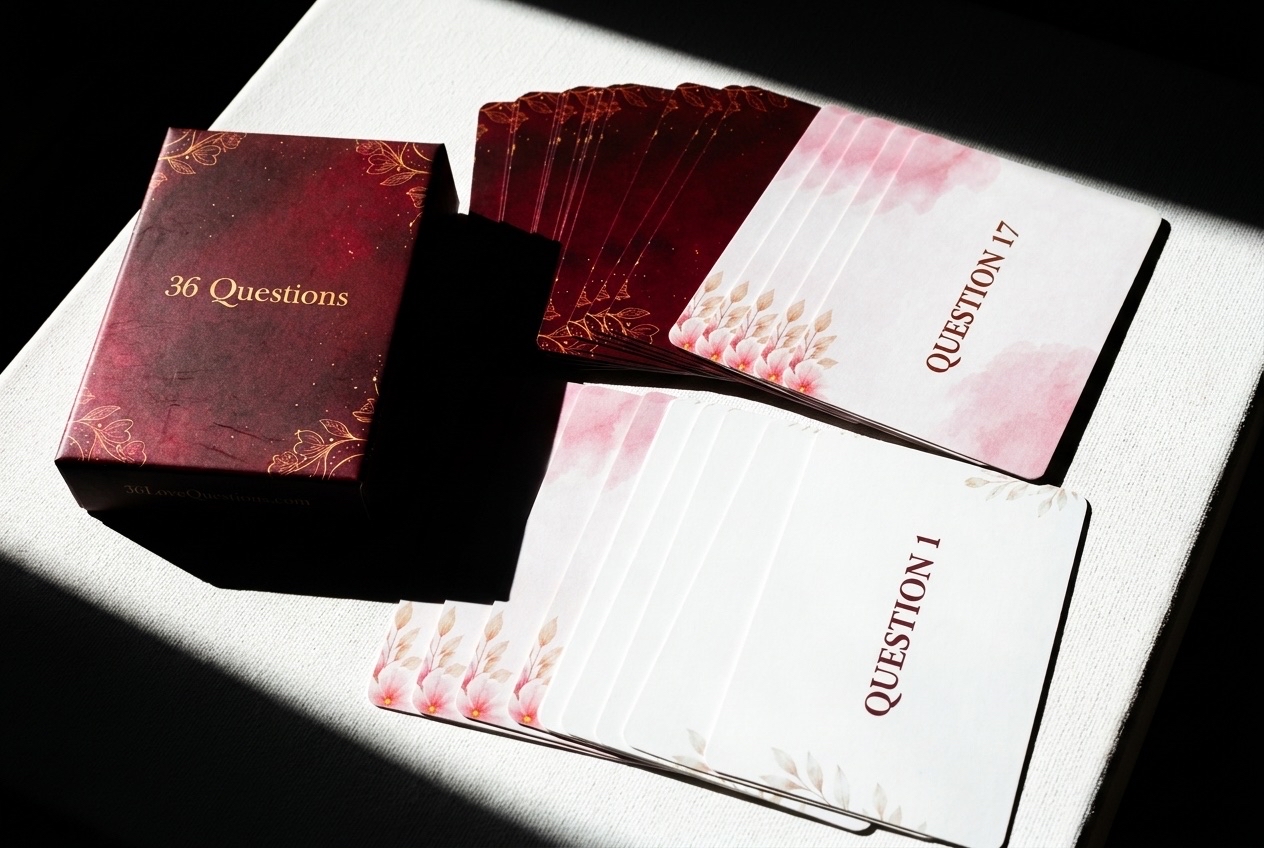
You have three options:
- Both have a copy of the deck. Best option. Each card is held in your hands: the form factor that matters in person is preserved on both ends. If you have our deck or have printed cards, this works beautifully.
- One person has the deck, the other doesn't. The card-holder reads each prompt out loud. Slightly asymmetric but workable.
- Read from a list on a phone or tablet. Worst of the three but functional. Use a separate device from your video call so the list isn't on top of your partner's face.
Whoever holds the deck on either end follows the same rule as in person: the reader of a card answers first, then the partner answers.
The eye contact, modified
The four-minute eye contact is the part that translates least well over video. A few options, in order of how much we like them:
Option A: Do it anyway. Set a four-minute timer. Look into the camera, not at your partner's image. Yes, you'll both be looking past each other slightly; yes, it will feel artificial; do it anyway. The shared silence and the held attention are doing most of the work.
Option B: Voice-only stillness. Set a timer for four minutes. Both of you close your eyes. No talking. This is a different exercise but produces a real intimacy in its own right.
Option C: Skip and replace with a longer debrief. Set a timer for ten minutes after the last card and just talk about what came up. Less effective than the eye contact, but better than rushing off the call.
We genuinely recommend Option A. It feels strange and works.
Which cards land harder long-distance
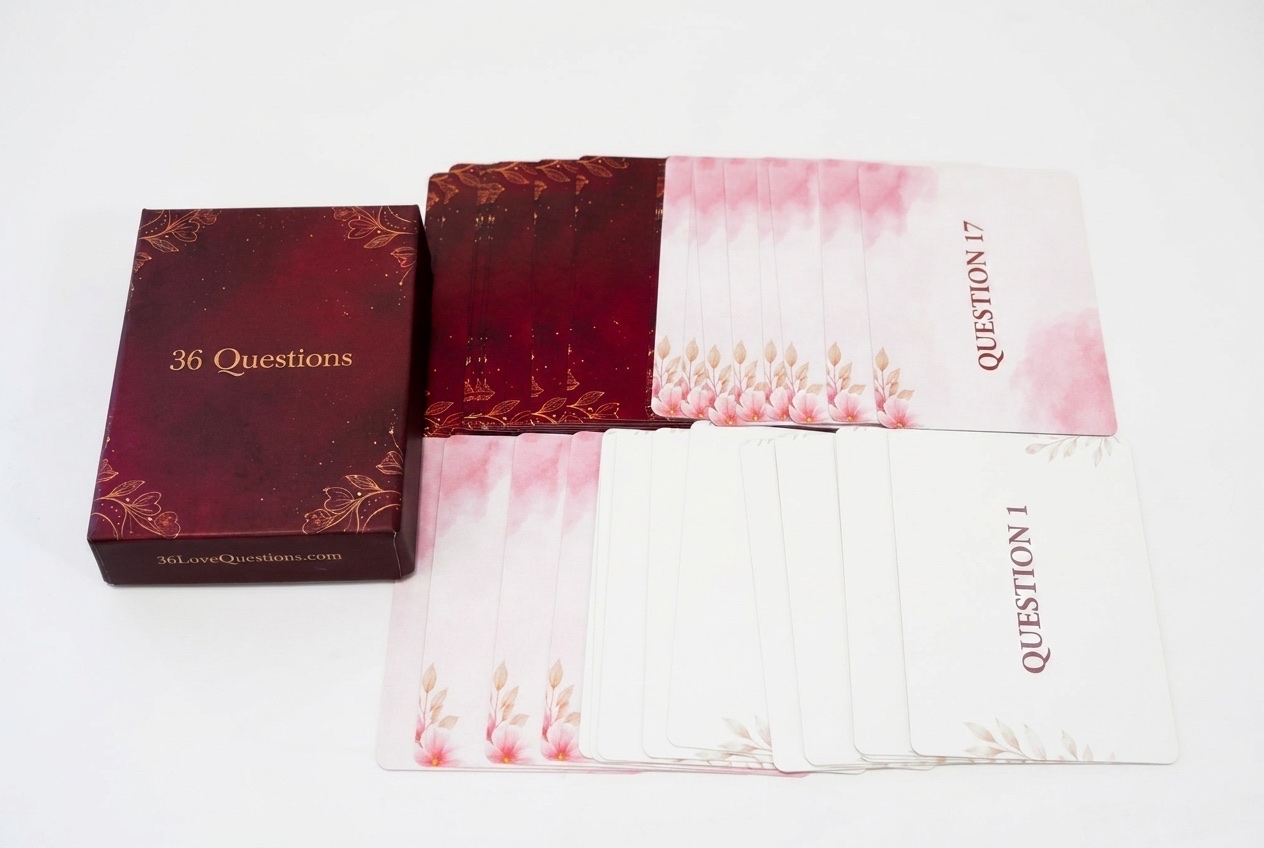
Long-distance couples report a few specific cards hitting harder than they would in person:
- Card 14 (something you've dreamed of doing, why haven't you done it?). The "why" gets sharper when distance is part of the answer.
- Card 26 ("I wish I had someone with whom I could share..."). Sometimes brutal long-distance.
- Card 27 (what to know about you to be a close friend). Long-distance partners often have less day-to-day data on each other than co-located partners and this card recalibrates.
- Card 33 (regret not having told). The geographic separation makes "haven't told" more visible.
A few cards land less well long-distance:
- Card 22 (positive characteristics, alternate sharing five). Without physical presence, this can feel rote. Slow it down deliberately.
- Card 28 (what you like about your partner). Same: make sure both of you take the full time.
A protocol for the night
A version that works well for couples in different time zones:
- 30 minutes before: both of you stop working. Eat something. Don't pre-talk about the questions.
- 5 minutes before: dial in. Set the camera. Confirm video, audio, lighting.
- First 5 minutes of the call: literally just say hello and look at each other. Don't start the deck immediately.
- Set I: ~25 minutes.
- Brief check-in between sets (not a break, just "ready?"). Keep your seats.
- Set II: ~25 minutes.
- Set III: ~25 minutes. Slow down on cards 28 and 33.
- Eye contact / shared silence: 4 minutes.
- Open debrief: as long as you want.
- End the call. Don't switch to a normal "how was your day" call afterwards. Let the night end.
Things long-distance couples specifically tell us
A few patterns from couples who've done this remote:
- The questions are especially valuable in the first six months of long-distance, when you're still building a model of each other but lack the small physical data of being in the same place.
- Couples who've been long-distance for years tell us the questions surface things that have drifted in the relationship without anyone noticing: small assumptions about the other person that are no longer accurate.
- Several couples have described doing the questions on the night before a planned visit, treating them as a kind of runway for the in-person time.
Closing thought
Long-distance is one of the situations the 36 questions were never designed for and one of the situations they help most. The shared structured attention (for 90 minutes, in the same call, both looking at each other) replicates one of the things distance most reliably steals from a relationship.
A small bonus: the day-after follow-up
A move that's almost unique to long-distance couples and that we've seen work very well: the day after the call, send each other one paragraph.
Not a long letter. One paragraph each, delivered any time on the next day, with the answer to a single prompt: what's something from last night that's still sitting with me today?
This is doing for long-distance what the in-person debrief does for co-located couples: letting the night land and produce its second wave. Because long-distance partners can't share the slow morning after, the written paragraph is the substitute. Several couples have told us they kept the paragraphs: they accumulate over a year into a small archive of the things the questions surfaced.
Keep it short. One paragraph. Send it without overthinking. The discipline of brevity is part of why it works.
If you want the experience that includes both of you holding actual cards on both ends, our deck is here (some couples buy two copies, one each, and ship one to their partner). It's not necessary, but it makes the call feel less like a meeting.